


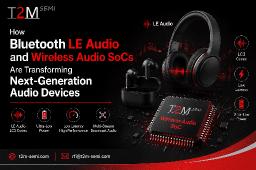
The wireless audio industry has undergone a remarkable transformation over the past decade. Consumers now expect seamless wireless connectivity, high-quality sound, ultra-low latency, extended battery life, and reliable performance across earbuds, speakers, gaming headsets, hearing aids, and smart audio devices.
Traditional Bluetooth audio solutions have served the industry well, but the growing demand for better audio quality and improved power efficiency has accelerated the adoption of Bluetooth LE Audio. Combined with modern wireless audio SoCs, LE Audio is enabling a new generation of connected audio products that deliver superior user experiences while reducing power consumption.
As the market continues to evolve in 2026, Bluetooth LE Audio is becoming one of the most important technologies shaping the future of wireless audio.
For many years, Bluetooth Classic was the dominant technology for wireless audio transmission. While it enabled wireless music streaming and voice communication, it was not specifically optimized for power efficiency.
As portable audio devices became smaller and battery life expectations increased, manufacturers began searching for more efficient alternatives.
Bluetooth LE Audio was developed to address these challenges. Built on Bluetooth Low Energy technology, LE Audio introduces improved audio quality, lower power consumption, enhanced scalability, and support for entirely new use cases.
The result is a more flexible and efficient platform capable of supporting modern wireless audio requirements.
One of the most significant innovations introduced by LE Audio is the LC3 codec.
LC3 delivers better audio quality at lower bitrates compared to traditional Bluetooth audio codecs. This allows devices to maintain excellent sound performance while reducing power consumption and bandwidth requirements.
LE Audio also introduces multi-stream audio capabilities. This feature enables multiple synchronized audio streams to be transmitted simultaneously, improving performance in applications such as true wireless stereo earbuds.
Broadcast audio is another important advancement. Users can share audio streams with multiple compatible devices, opening new possibilities for public audio systems, entertainment venues, airports, and educational environments.
These improvements make LE Audio far more versatile than previous Bluetooth audio technologies.
At the heart of every wireless audio product is a wireless audio SoC.
Modern Bluetooth audio SoCs integrate processing resources, audio DSP capabilities, wireless connectivity, memory, security functions, and power management into a highly compact platform.
This level of integration simplifies product development while reducing overall system cost and board complexity.
Wireless audio SoCs are now widely used in earbuds, headphones, speakers, gaming accessories, conference systems, hearing aids, voice-controlled devices, and smart wearables.
As audio products become increasingly sophisticated, highly integrated SoCs are becoming essential for delivering premium user experiences.
Latency remains one of the most important performance metrics in wireless audio.
For music playback, moderate latency may not significantly impact the user experience. However, gaming, voice communication, video streaming, and interactive applications require extremely low latency to ensure synchronization between audio and visual content.
Modern low-latency wireless audio SoCs utilize advanced radio architectures, optimized protocol stacks, and efficient audio processing pipelines to minimize delays.
These technologies allow users to enjoy immersive gaming experiences, clear voice communication, and responsive multimedia playback without noticeable lag.
As gaming and real-time communication continue to grow, demand for low-latency audio solutions is expected to increase significantly.
Battery life is a critical consideration for portable audio devices.
Consumers expect earbuds and wireless headsets to provide extended listening time while maintaining compact form factors.
BLE audio SoCs are specifically designed to maximize energy efficiency. By leveraging Bluetooth Low Energy communication and optimized audio processing, these devices can significantly reduce power consumption compared to traditional implementations.
The combination of LC3 audio compression and advanced power management techniques allows manufacturers to deliver longer battery life without sacrificing audio quality.
This capability is particularly important for true wireless stereo products where battery capacity is inherently limited.
While earbuds and headphones are among the most visible applications of Bluetooth LE Audio, the technology extends far beyond consumer entertainment.
Hearing aids can benefit from improved audio quality and lower power consumption. Conference systems can leverage multi-stream audio capabilities for enhanced communication experiences.
Industrial communication devices, smart wearables, healthcare products, and voice-enabled IoT systems are also adopting LE Audio technologies to improve performance and efficiency.
The flexibility of Bluetooth LE Audio makes it suitable for a wide range of connected applications.
Developing modern audio products requires more than just hardware.
Bluetooth audio stack solutions provide the software framework necessary to support advanced audio features, wireless communication protocols, device management, and interoperability.
Well-optimized audio stacks help manufacturers accelerate development while ensuring compatibility with evolving Bluetooth standards.
As LE Audio adoption continues to grow, robust Bluetooth audio stack solutions will become increasingly important for successful product deployment.
Several trends are expected to shape the wireless audio market in the coming years.
Artificial intelligence is increasingly being integrated into audio products to support noise cancellation, voice enhancement, adaptive equalization, and contextual audio processing.
Ultra-low-power architectures will continue improving battery life while supporting more advanced functionality.
The combination of wireless audio SoCs, Edge AI, and Bluetooth LE Audio will create intelligent devices capable of delivering personalized and immersive experiences.
Emerging technologies such as spatial audio, advanced hearing assistance, and context-aware audio processing will further expand the capabilities of connected audio products.
T2M SEMI’s Bluetooth LE Audio represents one of the most significant advancements in wireless audio technology. Through improved efficiency, enhanced audio quality, lower latency, and innovative new features, it is enabling the next generation of connected audio experiences.
Combined with highly integrated wireless audio SoCs, LE Audio is transforming earbuds, speakers, gaming devices, hearing aids, and professional communication systems.
As the wireless audio industry continues to evolve, manufacturers that embrace Bluetooth LE Audio and advanced audio SoCs will be well positioned to deliver innovative products that meet the growing expectations of modern consumers.
| No comments yet. Be the first. |
