


The connected technology ecosystem is evolving at an unprecedented pace as smart homes, industrial IoT systems, wireless audio products, gaming devices, and intelligent consumer electronics become an essential part of modern life. With this rapid growth comes the increasing demand for advanced wireless solutions capable of delivering reliable communication, ultra-low power operation, strong security, and seamless connectivity across multiple devices and applications.
Modern wireless devices are no longer limited to simple data transfer functions. Today’s connected products require continuous communication, fast response times, low latency, extended battery life, and secure connectivity in highly crowded wireless environments. To meet these evolving requirements, semiconductor manufacturers are developing highly integrated wireless platforms that combine multiple communication technologies into compact and energy-efficient architectures.
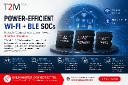
T2M’s portfolio of Wi-Fi + Ble System-on-Chip solutions is specifically engineered to address these modern connectivity challenges. These highly integrated SoCs combine advanced Wi-Fi and Bluetooth Low Energy technologies into a single platform optimized for seamless co-existence, low power consumption, robust security, and simplified hardware integration. By integrating RF functionality, wireless communication, processing resources, power management, and security features into compact architectures, T2M enables developers and OEMs to accelerate product innovation while reducing system complexity and overall development cost.
As IoT adoption expands across industries, wireless connectivity has become one of the most critical components in electronic product design. Smart devices must support stable communication while operating efficiently within limited power budgets and compact form factors. Consumers and enterprises increasingly expect connected products to deliver uninterrupted performance, rapid wireless communication, and secure data exchange regardless of operating conditions.
Traditional wireless solutions often require separate Wi-Fi and Bluetooth chipsets, increasing system complexity, PCB size, power consumption, and production cost. Integrated combo SoCs solve these challenges by combining multiple wireless technologies into a unified architecture, simplifying hardware design and improving operational efficiency.
T2M’s Wi-Fi + BLE SoCs are designed to deliver highly optimized wireless connectivity for smart devices that require efficient communication, enhanced performance, and long operational life. These integrated solutions enable manufacturers to build scalable products suitable for smart homes, industrial automation, wearables, connected healthcare systems, gaming peripherals, smart appliances, and edge AI platforms.
One of the most significant advantages of T2M’s wireless SoC portfolio is its support for dual-mode connectivity through the integration of Wi-Fi 6 and Bluetooth Low Energy technologies. Wi-Fi 6 provides improved throughput, enhanced network efficiency, reduced latency, and better performance in dense wireless environments compared to earlier wireless standards. This makes it highly suitable for modern applications that require continuous wireless communication and high-speed data transfer.
Bluetooth Low Energy complements Wi-Fi functionality by enabling low-power communication for sensors, peripherals, wireless audio devices, and battery-operated IoT systems. The integration of these technologies within a single chip allows devices to benefit from both high-performance networking and energy-efficient wireless communication simultaneously.
This dual-mode capability is particularly valuable for applications such as smart speakers, wireless gaming devices, smart appliances, industrial monitoring systems, and wearable electronics, where different wireless functions must operate together without compromising power efficiency or system reliability.
One of the major technical challenges in wireless product development is ensuring reliable co-existence between Wi-Fi and Bluetooth communication. In many devices, simultaneous operation of multiple radios can create interference issues that negatively impact connectivity, data throughput, and user experience.
T2M addresses this challenge through advanced co-existence technologies integrated within its wireless SoCs. The devices utilize intelligent Full-MAC architectures and optimized wireless scheduling mechanisms that coordinate Wi-Fi and Bluetooth communication efficiently. This allows both wireless technologies to operate simultaneously with minimal interference while maintaining stable connectivity and low latency.
These co-existence capabilities are particularly important in connected audio systems, smart home devices, gaming peripherals, and industrial IoT applications where uninterrupted wireless performance is essential for reliable operation.
Power efficiency has become one of the most important design considerations for connected electronics, especially in battery-powered devices and always-on IoT systems. Wireless communication can significantly impact battery life if not properly optimized, making low-power wireless architecture essential for modern smart products.
T2M’s Wi-Fi + BLE SoCs incorporate advanced low-power technologies designed to reduce energy consumption while maintaining reliable wireless performance. Features such as optimized sleep modes, intelligent RF management, and Target Wake Time technology help devices minimize power usage during inactive periods without sacrificing connectivity.
These energy-efficient design techniques enable extended battery life and reduced operational costs across a wide range of applications, including wearable devices, wireless sensors, smart home products, portable electronics, and industrial IoT systems.
As connected devices become more deeply integrated into personal, industrial, and enterprise environments, wireless security has become a critical requirement. IoT ecosystems are increasingly targeted by cyber threats that can compromise sensitive data, network infrastructure, and device functionality.
To address these concerns, T2M integrates advanced security technologies into its wireless SoC platforms. The devices support modern security standards, including WPA3 authentication, AES encryption, secure boot mechanisms, and hardware cryptographic acceleration to ensure robust data protection and secure wireless communication.
These security capabilities help manufacturers develop connected products capable of protecting sensitive information while ensuring reliable system operation across smart homes, industrial automation systems, healthcare devices, and cloud-connected electronics.
The T2M6600 Series is a highly optimized low-power Wi-Fi + Bluetooth® LE combo SoC designed for smart home and IoT applications. The device supports Wi-Fi 6 based on 802.11 ax/b/g/n standards together with Bluetooth LE 5.0 connectivity within the 2.4GHz frequency band.
The T2M6600 integrates Full MAC Wi-Fi functionality, RF components, power management circuitry, and amplifiers into a single compact architecture. This high level of integration simplifies hardware design while reducing system cost and PCB complexity.
Powered by a 240 MHz RISC processor, the T2M6600 delivers efficient processing performance suitable for connected IoT environments. The device also includes extensive peripheral interfaces and advanced security features that provide flexibility for a wide range of wireless applications.
Its low-power architecture and integrated wireless functionality make the T2M6600 particularly suitable for devices requiring stable connectivity, compact design, and energy-efficient operation.
The T2M6600 Series is ideal for smart home systems, wireless sensors, smart lighting platforms, connected appliances, IoT control systems, and various consumer electronics applications.
The T2M6630 is a highly integrated Wi-Fi and Bluetooth® LE combo SoC developed around an ARM StarSE MCU architecture based on Armv8-M technology with TrustZone security support.
The device supports 1x1 Wi-Fi 6 connectivity together with Bluetooth LE operation within the 2.4GHz spectrum, providing reliable wireless communication with optimized power efficiency and long-range performance.
A key advantage of the T2M6630 is its advanced security architecture enabled by TrustZone technology. This allows developers to implement secure wireless communication, protected application execution, and advanced device authentication for security-sensitive IoT applications.
The SoC also incorporates optimized RF and baseband architecture, embedded memory, high-speed SDIO support, and extensive peripheral interfaces to support scalable wireless product development.
The T2M6630 is well suited for secure IoT platforms, industrial automation systems, connected sensors, embedded wireless controllers, smart home infrastructure, and intelligent edge devices requiring strong security and reliable wireless performance.
The T2M6700 Series is a high-performance wireless combo solution engineered for advanced connectivity applications requiring optimized power efficiency and high-speed wireless communication.
The SoC integrates Wi-Fi 6 and Bluetooth 5.0 functionality within a compact architecture that combines a Wi-Fi 6 compliant MAC, 1T1R baseband, and RF front-end into a single chip solution.
The T2M6700 supports both 2.4GHz and 5GHz wireless operation with 40MHz bandwidth and 256 QAM modulation, enabling enhanced wireless throughput and improved network efficiency.
The device also supports multiple host connectivity interfaces including SDIO 3.0, USB 2.0, and high-speed UART for flexible integration across different embedded system architectures.
Advanced time-division duplex co-existence technology ensures efficient coordination between Wi-Fi and Bluetooth communication, reducing interference and improving overall system stability.
The T2M6700 is ideal for gaming devices, connected audio products, smart displays, high-performance IoT systems, edge computing platforms, and next-generation consumer electronics that require low latency and reliable wireless connectivity.
The future of connected technology depends heavily on reliable, secure, and energy-efficient wireless communication solutions. As smart devices become increasingly advanced and interconnected, the need for highly integrated wireless platforms capable of supporting multiple connectivity standards will continue to grow.
T2M’s Wi-Fi + Bluetooth® LE SoC portfolio addresses these evolving industry requirements through advanced wireless integration, optimized power efficiency, seamless co-existence technologies, and robust security architectures. The T2M6600, T2M6630, and T2M6700 Series provide scalable wireless solutions designed to accelerate product development while simplifying hardware integration and reducing overall system complexity.
By continuously advancing semiconductor innovation and wireless connectivity technologies, T2M remains committed to enabling the next generation of intelligent, connected, and energy-efficient smart devices for the evolving IoT and consumer electronics ecosystem.
The rapid growth of IoT devices, smart homes, and wearable technology has created a strong demand for efficient wireless solutions. At the center of this transformation is the Bluetooth LE SoC, a compact and highly integrated platform that enables reliable communication while maintaining extremely low power consumption. As industries move toward smarter and more connected ecosystems, choosing the right Bluetooth Low Energy chip becomes critical for performance, battery life, and scalability.
A BLE SoC (Bluetooth Low Energy System-on-Chip) integrates a microcontroller, RF transceiver, memory, and security features into a single chip. This level of integration allows developers to build compact, efficient devices without relying on multiple external components. Modern Bluetooth low energy chipsets are designed to support not only BLE communication but also advanced features such as mesh networking, secure connections, and multi-protocol operation.
Unlike traditional wireless solutions, a low-power Bluetooth SoC is optimized for devices that need to run for months or even years on small batteries. This makes it ideal for applications like wearables, asset tracking, smart sensors, and industrial IoT systems.
Power efficiency is one of the most important factors in IoT device design. An ultra low power BLE SoC ensures minimal energy consumption during both active communication and sleep modes. This directly translates into longer battery life and reduced maintenance costs.
Today’s ultra low power Bluetooth chips are engineered with advanced power management techniques, including deep sleep states, efficient DC-DC conversion, and optimized RF performance. These innovations enable developers to build devices that deliver high performance while consuming very little energy.
As demand grows for low power wireless SoC solutions, manufacturers are focusing on balancing performance, connectivity, and energy efficiency in a single platform.
The latest generation of BLE connectivity ICs goes beyond simple Bluetooth communication. Many modern SoCs support multiple wireless standards such as Zigbee, Thread, and Matter alongside BLE. This evolution allows a single chip to operate across different ecosystems, improving interoperability and reducing system complexity.
Devices built using a BLE WiFi SoC or WiFi BLE SoC combination can connect seamlessly to both local networks and cloud platforms. This flexibility is especially valuable in smart home and industrial environments where multiple communication protocols must coexist.
Multi-protocol support also plays a key role in enabling scalable IoT deployments, making it easier to expand networks without redesigning hardware.
The versatility of Bluetooth low energy chips has led to their widespread adoption across multiple industries. In consumer electronics, they power wearables, earbuds, and smart home devices. In industrial environments, they are used for monitoring systems, asset tracking, and predictive maintenance.
The rise of low power Bluetooth devices has also driven innovation in healthcare, where energy-efficient connectivity is essential for continuous monitoring solutions. Additionally, applications such as electronic shelf labels, beacons, and smart locks rely heavily on ultra low power microcontrollers with Bluetooth for reliable and long-lasting performance.
A modern IoT BLE MCU combines processing power with wireless connectivity, enabling edge computing capabilities within the device itself. This reduces latency and improves overall system efficiency.
With advancements in architecture, many BLE MCU modules now feature high-performance cores, increased memory capacity, and enhanced security features. These improvements allow developers to build more complex applications while maintaining low power consumption.
The integration of a low power MCU with Bluetooth simplifies design and reduces the need for external components, making it easier to bring products to market faster.
As IoT devices become more connected, security becomes a top priority. Modern Bluetooth low energy chipsets include built-in security features such as encryption, secure boot, and hardware-based random number generation.
These features ensure that devices using a BLE chip can protect sensitive data and maintain secure communication channels. For industries like healthcare, industrial automation, and smart homes, this level of security is essential.
Reliability is equally important, and today’s BLE chipsets are designed to operate in challenging environments with stable RF performance and robust connectivity.
T2M Semiconductor offers a comprehensive Bluetooth LE product portfolio designed to meet the evolving needs of IoT developers. Their solutions range from ultra-low-power BLE SoCs to advanced multi-protocol platforms supporting Zigbee, Thread, and Matter.
These SoCs are built with high-performance RISC-V MCUs, integrated security engines, and optimized RF designs to deliver reliable connectivity and long battery life. Whether it’s a standalone BLE SoC, a BLE SoM, or a highly integrated Bluetooth low energy chipset, T2M Semiconductor provides scalable solutions for a wide range of applications.
Their portfolio is particularly well-suited for developers looking for the best low power wireless MCUs SoCs, Bluetooth, WiFi, Zigbee, Thread, Matter 2026, offering flexibility, performance, and future-ready connectivity.
Selecting the right Bluetooth LE SoC depends on several factors, including power consumption, processing capability, connectivity requirements, and security features. Developers should consider whether they need a single-protocol solution or a multi-protocol platform that supports various wireless standards.
For battery-powered devices, an ultra low power BLE microcontroller is essential to maximize operational life. For more complex applications, a BLE audio SoC or a multi-protocol SoC may be required to handle higher data throughput and advanced features.
Understanding the specific requirements of your application will help you choose the most suitable Bluetooth low energy chips for optimal performance and efficiency.
The evolution of Bluetooth LE SoCs is driving innovation across the IoT landscape. From wearables and smart homes to industrial automation, these chips enable efficient, secure, and scalable wireless connectivity.
As technology continues to advance, the demand for ultra low power Bluetooth solutions will only increase. By leveraging modern BLE SoCs and choosing the right platform, developers can build next-generation devices that deliver exceptional performance while maintaining energy efficiency.
With companies like T2M Semiconductor leading the way, the future of low-power wireless connectivity looks more promising than ever.
The technology environment in the world today is going through a stage of transforming into a stage where connectivity, intelligence, and energy efficiency are not independent design accomplishments but closely affiliated demands. With billions of devices shifting down to the edge, with processing happening at the edge, and still retained securely connected, the semiconductor market is facing new architectural and system-level issues.
The companies, engineers, and ecosystem partners that make this next generation of connected systems are gathered in MWC Barcelona 2026, which will be held on 250 March in Barcelona. T2M-SEMI shall be present at MWC Barcelona 2026, where it shall be holding discussions with its industry stakeholders on how scalable, low-power, and secure silicon platforms can be deployed in the real world to respond to IoT and edge applications faster.
IoT has come out of the sensor network. Today’s deployments demand:
To satisfy these needs, semiconductor solutions that are built at a system level with system-level awareness are needed. T2M-SEMI is devoted to facilitating this shift by offering a suite of wireless and AI-ready System-on-Chip (SoC) platforms and modules to meet the existing and emerging standards of connectivity.
Any connected product is centered on strong wireless communication. The technology offered by T2M-SEMI has a wide variety of connectivity choices to ensure a wide variety of deployment conditions and regulatory needs.
Bluetooth Low Energy (LE) is an industry pillar in the short-range communication with low power usage in wearables, medical, asset monitoring, and consumer electronics applications. Its changing feature set is still able to maintain greater data efficiency and solid coexistence.
Wi-Fi is important in places where an increased throughput and IP-native connectivity are necessary, especially at gateways, smart infrastructure, and industry. Performance and power consumption are two of the major areas of design.
Mesh, Matter, and Thread are becoming significant to interoperable building and smart home ecosystems. The protocols are used to deal with the problem of fragmentation by allowing communication between devices from different vendors, but still ensuring security and reliability.
Sub-GHz and Wi-SUN technologies offer long-range and high-capacity deployment with low-energy usage, and are therefore applicable in smart cities, utilities, and industrial monitoring.
Moreover, Cellular IoT (Cat-1 bis) provides a sensible balance of bandwidth, range, and global scalability to applications that are not closely connected to the cloud complex infrastructure.
The integration of GNSS also provides accurate location awareness, which can be used in logistics tracking, mobility, and infrastructure monitoring use cases.
Connectivity is no longer a sufficient condition. With the increasing data volumes and the reduction in latency, intelligence is going to be shifted to the edge. AI Ultra-low-power devices can process sensor data on the device to save on bandwidth, minimize response time, and improve privacy.
This shift is supported by T2M-SEMI as it offers embedded intelligence on a stringent power and cost budget by using AI-ready SoCs and modules. The platforms are expected to combine machine learning with wireless support, which gives developers the ability to design smarter and more autonomous devices without the need to over-complicate the systems.
Among the problems that arise repeatedly during the development of IoT is the disconnect between successes during the prototype phase and commercial use. The choice of architecture at an early stage (connectivity, power management, security, and software integration) can have a great influence on long-term reliability and scalability.
T2M-SEMI operates within this lifecycle and helps customers in defining their concept up to production-ready solutions. Going by the ability of silicon and the real deployment needs, the emphasis is on the minimization of development cycles and the reduction of risk as products scale.
MWC Barcelona offers a special place to share knowledge in the whole connectivity ecosystem, including silicon and modules, devices, platforms, and services. The fact that T2M-SEMI will attend MWC Barcelona 2026 demonstrates that this company believes in collaboration and discussion on the future of connected and intelligent systems.
To engineers, product teams, and ecosystem partners who are present at the event, MWC will provide the ability to discuss how changing wireless standards, edge intelligence, and power-efficient design can be integrated into deployable solutions.
With the growth of the IoT systems in terms of scale and complexity, the importance of versatile, effective, and safe semiconductor platforms grows. The next stage of connected innovation will be determined by the convergence of multi-protocol connectivity and edge intelligence.
T2M-SEMI is looking forward to meeting the technology community in the world at MWC Barcelona 2026 and discussing how partnering with silicon and system design can help the dawn of the next generation of connected products, both in small-scale and in large scale deployment.