


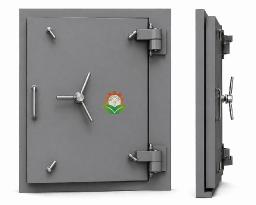
Blast resistant doors in India's critical infrastructure — from DRDO facilities to AIIMS Jammu to DLF commercial towers — used to mean industrial steel vaults that clashed with interior design. Today, facility managers and procurement teams can specify doors that protect against 0.5–26 bar overpressure while matching wood finishes, modern aesthetics, or corporate branding. This article explains what customization options exist, where engineering limits kick in, and how Indian buyers can balance safety with design intent without compromising STANAG 2280 certification.
A blast door accepts custom finishes (wood veneer, powder coating, stainless steel cladding) while maintaining blast rating, provided the core steel plate (8–25mm thick) and I-beam reinforcement stay unchanged. Customization adds ₹3,000–₹8,000/sqm and 2–4 weeks to lead time, with SS316 cladding lasting 30+ years in coastal conditions.
Blast resistant doors absorb explosive pressure through a reinforced steel core: solid homogeneous plates (8–25mm) with internal I-beam stiffeners engineered for 0.5–26 bar peak reflected overpressure. Custom finishes are non-structural cladding applied to the steel surface, separated from the load-bearing system by adhesive bonding layers.
The engineering breakdown works like this:
Sigma Power Tech Blast Door systems separate structural and aesthetic layers, allowing finish changes without re-certification. However, added weight beyond 200kg per leaf requires hinge re-rating for 50,000+ cycle performance.
Technical Note: For coastal facilities (Mumbai, Chennai, Vizag), specify SS316 cladding over wood veneer. Salt spray degrades wood within 3–5 years, while SS316 maintains appearance for 20–30 years with minimal maintenance.
Different sectors in India prioritize aesthetics differently. Defence installations and PSU refineries (Indian Oil, BPCL, NTPC) focus on raw performance — appearance is secondary. However, commercial complexes (DLF, Lulu Mall), hospitals (AIIMS), and VIP residences in Mumbai/Delhi/Bangalore require security blended with interior design.
NBC 2016 smart building mandates push for architectural integration in commercial and residential projects. A 2.5m × 2.5m blast proof door at 10 bar rating can accept wood veneer, high-pressure laminate, or powder-coated cladding without reducing blast resistance, provided added weight stays within hinge capacity. A blast proof door manufacturers in India supplier like Sigma Power Tech offers double-leaf configurations with concealed hinges matching surrounding architecture.
Custom finishes add ₹3,000–₹8,000/sqm to blast door price. Wood veneer adds ₹4,000–₹6,000/sqm, powder coating adds ₹2,000–₹4,000/sqm, and SS316 cladding adds ₹6,000–₹8,000/sqm. Lead time extends from 6–10 weeks (standard) to 8–14 weeks (customized).
Facility managers and EPC contractors frequently make specification errors that compromise long-term performance or void certification:
Mistake 1: Choosing finishes that exceed weight limits
Vinyl wraps, thick stone cladding (10mm+), or heavy tiles add 50–80kg beyond hinge capacity. Hinges fail after 3–5 years in high-traffic facilities, causing misalignment and blast rating voidance. Only finishes under 5mm thickness and 40kg weight are safe without structural re-engineering.
Mistake 2: Ignoring fire rating compatibility with veneer
Blast doors often double as FD60/FD120 fire-rated doors per NBC 2016. Wood veneer must be fire-treated (IS 9664 compliance) to maintain fire rating. Untreated veneer reduces fire resistance from 120 minutes to 30–45 minutes, violating IS 9664 and NBC 2016 Part 4.
Mistake 3: Rushing curing and acclimatization timelines
Powder coating requires 24–48 hours curing at 180°C. Wood veneer needs 5–7 days acclimatization to Indian humidity (70–90% RH). Rushing causes bubbles, peeling, or delamination within 6–12 months, requiring ₹15,000–₹40,000 repairs.
For a deeper technical overview of blast resistant doors, including relevant engineering specifications and standards, review the Blast resistant doors resource from Sigma Power Tech.
FAQ
Q: What is a blast resistant door and can it be customized for decor?
A: A blast resistant door is a reinforced steel barrier engineered to withstand explosive pressure waves from 0.5–26 bar overpressure, using solid homogeneous steel plates with I-beam reinforcement. Yes, it accepts wood veneer, powder coating, or stainless steel cladding while maintaining STANAG 2280 certification, provided core steel thickness (8–25mm) stays unchanged and added weight remains under 200kg per leaf.
Q: What standards apply to customized blast doors in India?
A: Customized blast doors must meet STANAG 2280 (NATO) for blast certification, NBC 2016 Part 4 for fire safety, and IS 9664 for fire-treated wood veneer. Fire-treated veneer is mandatory to maintain FD120 rating. For coastal facilities, ASTM A775 epoxy coating or SS316 cladding ensures 20+ year corrosion resistance.
Q: How much does custom finishing add to blast door price and delivery time?
A: Custom finishes add ₹3,000–₹8,000/sqm to blast door price and 2–4 weeks to lead time. Wood veneer adds ₹4,000–₹6,000/sqm (2–3 weeks), powder coating adds ₹2,000–₹4,000/sqm (1 week), SS316 cladding adds ₹6,000–₹8,000/sqm (3–4 weeks). Total delivery is 8–14 weeks for customized vs. 6–10 weeks for standard doors.
| No comments yet. Be the first. |
