

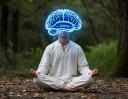
For millennia, contemplative traditions mapped the mind through inner observation. Today, neuroscience uses fMRI, EEG, and molecular biomarkers to explore this exact terrain. Modern research reveals that contemplative stillness is not passive rest, but an active, highly coherent state of neurobiological optimization—forming a "Diamond Bridge" between ancient wisdom and empirical science.
Long-term contemplative practice alters both the structure and function of key brain regions:
As high-frequency Beta waves (13–30 Hz) associated with stress and calculation settle, the brain shifts into restorative frequencies:
Patanjali’s Yoga Sutras defines yoga as "chitta vritti nirodha" (stilling the fluctuations of the mind). Modern cognitive science mirrors this via predictive processing: the brain acts as an inference engine constantly projecting models of reality. Stillness quiets these agitated predictive simulations, revealing a clear, non-dual witnessing awareness.
Consciousness is deeply somatic. Yogic focus on breath and alignment cultivates interoception the awareness of internal bodily signals (heart rate, respiration). This activates and expands the insular cortex, allowing individuals to detect the physical precursors of stress before they escalate into compulsive reactions.
Ancient concepts like Samskaras (subconscious impressions) parallel Hebbian synaptic plasticity ("neurons that fire together, wire together"). Through non-reactive observation (Vairagya), meditators interrupt automatic habit loops and starve negative pathways, wiring healthier neural connections.
Stillness cannot be forced by willpower; the body must register safety. Yogic breathwork (pranayama), particularly prolonged exhalations, stimulates the Vagus nerve. This shifts the autonomic nervous system from sympathetic ("fight-or-flight") to parasympathetic ("rest-and-digest"), releasing acetylcholine, lowering heart rate, and reducing systemic inflammation.