


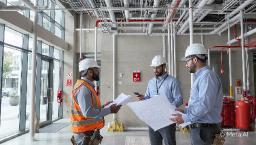
Fire safety assessments sometimes involve questions that cannot be answered through design documents alone. A drawing may show the intended arrangement, but the completed building may contain changes, damage or installation conditions that need closer examination. Physical observations, photographs, inspection records and project documents can help establish what was present and how it relates to the technical issue. A fire protection consultant can support building safety reviews by considering design information and relevant site conditions within the applicable Canadian regulatory framework.
Before visiting a building, an expert should understand the questions that need to be examined. A site assessment may be requested because parties disagree about a fire separation, an exit arrangement, a fire protection installation or the condition of a building element.
The purpose should be specific. A broad instruction to inspect everything may not provide a useful basis for a focused technical opinion. Instead, the reviewer should identify the disputed issues, the relevant locations and the information needed to assess them.
The scope should also establish whether the task involves documenting existing conditions, comparing construction with approved drawings, evaluating a reported defect or considering the technical significance of a particular observation. Clear objectives help make the inspection efficient and relevant.
Preparation helps an expert understand what to look for during an inspection. Useful information may include architectural plans, fire safety strategies, fire protection drawings, specifications, construction records, inspection reports and correspondence about the disputed issue.
The reviewer should identify important locations and details before attending the site. For example, if the dispute concerns a fire-resisting wall, the inspection may need to consider its continuity, openings, service penetrations and connections to adjacent construction.
Preparation should not lead the expert to assume that the documents accurately represent the completed building. The purpose of the visit is to examine available physical evidence and compare it with relevant records. Any difference should be documented objectively.
Site observations should be factual, clear and sufficiently detailed to support later review. Photographs can record the location and appearance of relevant building features, while written notes can explain what was observed and where it was found.
A useful record identifies the inspection date, location, observed condition and any limitations affecting the observation. Photographs should have enough context to show where the detail is situated. Close-up images may help document a particular feature, but wider views can be necessary to understand its relationship with surrounding construction.
An expert should distinguish between what was directly observed and what was reported by another person. For example, a visible opening in a wall is an observation. A statement about when that opening was created may require separate documentary or witness evidence.
A site inspection may involve several types of fire and life safety features. These can include fire-resisting walls and floors, fire doors, service penetrations, fire alarm devices, sprinkler installations, exit routes and smoke control components.
The review should remain relevant to the question being investigated. If a concern involves a fire separation, the expert may need to examine visible joints, openings, penetrations and supporting records. If the issue relates to egress, the inspection may consider route continuity, door operation, obstructions and the relationship between the occupied space and available exits.
Some elements cannot be fully assessed through visual observation. Concealed construction, system performance or material properties may require additional records, specialist testing or examination by an appropriately qualified professional. The report should state where the available inspection method is limited.
Physical evidence becomes more useful when it is considered alongside design and construction records. Approved drawings can show the intended arrangement, while shop drawings, change notices and inspection documents may explain how the work developed.
The expert should compare these sources carefully. If the site condition differs from an approved detail, the report should identify the difference and examine whether a documented change or approval explains it. If no supporting record is available, that absence should be stated without assuming why the record is missing.
This process can help distinguish between a design issue, a construction variation, a maintenance concern and an uncertainty caused by incomplete documentation. Each may require a different technical response.
A site observation does not automatically establish the cause of a fire, the responsibility of a project participant or the legal outcome of a dispute. The expert must explain what the evidence can support and where further investigation may be necessary.
For example, an observed defect may demonstrate that a particular condition exists. It may not establish when the defect developed or who was responsible for it. Those questions may require construction records, maintenance history, witness information or additional specialist investigation.
A fire protection consultant can help interpret fire and life safety design conditions and relate them to applicable code requirements. Where an opinion is prepared for a formal proceeding, the expert should explain the inspection method, evidence reviewed, assumptions and limitations in a transparent way.
Site inspections can provide important information when fire safety concerns involve differences between design intent and completed construction. Their value depends on clear objectives, accurate records and careful interpretation of the available evidence. Vortex Fire provides fire and life safety engineering consultancy in Canada, while its Fire Safety Expert Witness Services offer independent technical opinions on fire engineering matters. For disputes requiring professional interpretation of physical conditions and project records, Fire Safety Expert Witness Services can help communicate relevant findings clearly and impartially to courts, tribunals and stakeholders.
It can help establish the physical condition of relevant building features and identify differences between approved documents and completed work.
Architectural drawings, fire safety strategies, specifications, inspection reports, construction records and relevant correspondence may all be useful.
Photographs can document visible conditions, but they do not necessarily establish when a defect occurred or who was responsible.
No. Some conditions require testing, specialist examination or access to concealed construction and system records.
The expert should identify what is known, explain the evidence available and clearly state what cannot be concluded without further information.
| No comments yet. Be the first. |
