


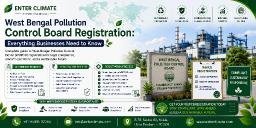
Starting a business is exciting, but it also comes with many responsibilities. One of the most important responsibilities is following environmental rules. These rules help keep our air, water, and land clean.
If you want to start or run an industry in West Bengal, you may need approval from the West Bengal Pollution Control Board (WBPCB). This registration is important because it shows that your business follows environmental laws and does not harm nature.
The West Bengal Pollution Control Board (WBPCB) is a government body that works to protect the environment in West Bengal. It helps control pollution and makes sure industries follow environmental rules.
The board checks whether factories, manufacturing units, hospitals, hotels, warehouses, and other businesses are managing pollution properly before they start operating.
Getting approval from the West Bengal Pollution Control Board is important because it helps businesses:
A business that follows environmental rules also creates a better future for everyone.
Many businesses need permission from WBPCB before starting operations. These may include:
The type of approval depends on the pollution level created by the business.
Businesses generally require two important approvals.
This approval is taken before setting up a factory or industrial unit. It confirms that the proposed project follows environmental guidelines.
After construction is completed, businesses must obtain Consent to Operate before starting commercial operations.
Both approvals help ensure that industries work responsibly and safely.
Although document requirements may vary depending on the business, the following are commonly required:
Keeping these documents ready helps speed up the approval process.
The registration process is simple when all documents are available.
Step 1: Identify the pollution category of your business.
Step 2: Prepare all required documents.
Step 3: Submit the online application.
Step 4: Pay the applicable government fee.
Step 5: The Pollution Control Board reviews the application.
Step 6: If required, officials may inspect the site.
Step 7: After successful verification, the approval certificate is issued.
Operating without the required pollution control approval can create serious problems, such as:
Following environmental regulations from the beginning saves time, money, and unnecessary stress.
Understanding pollution control rules can sometimes feel confusing. That is where Enterclimate helps.
Enterclimate supports businesses by providing guidance for Pollution Control Board registrations across India. Their team assists with:
With experienced professionals, businesses can complete the registration process more smoothly and focus on their growth.
Every Indian state has its own Pollution Control Board. Businesses operating in different states must obtain approvals from the respective board.
For example, businesses in Rajasthan may require a Rajasthan State Pollution Control Board NOC before starting industrial activities.
Companies planning projects in South India may need approval from the Telangana State Pollution Control Board, depending on the type of industry.
Similarly, industries operating in Chhattisgarh may require a Chhattisgarh Pollution Control Board NOC to meet environmental compliance requirements.
Although the names of the boards differ, their main objective is the same—to protect the environment while supporting responsible industrial development.
Environmental protection is everyone's responsibility. Whether your business is small or large, following pollution control rules is an important step toward sustainable growth.
Obtaining approval from the West Bengal Pollution Control Board not only keeps your business legally compliant but also shows your commitment to protecting nature and public health.
If you are planning to start a business or need assistance with Pollution Control Board registration, getting expert guidance can make the entire process faster and easier. Following the right steps today can help your business grow confidently tomorrow.
Upendra Sharma is an Environmental Compliance Consultant associated with Enterclimate, where he helps businesses understand environmental laws, Pollution Control Board approvals, EPR registrations, and regulatory compliance across India. He enjoys simplifying complex compliance topics into easy-to-understand guides so that entrepreneurs, startups, and industries can meet legal requirements with confidence while supporting environmental sustainability.
| No comments yet. Be the first. |
