


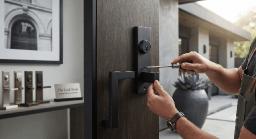
Front door locks and handles get looked at maybe twice in a homeowner's life - once when something breaks, and once during a reno when the rest of the house is getting a refresh anyway. Which is a bit odd, considering it's the one piece of hardware every single person touches on their way in and out, and the one thing standing between your house and anyone who fancies trying the handle after dark.
Internal doors mostly just need to open and close nicely. The front door has a harder job. It's doing security, first impressions and daily wear all at once, and a lot of people don't realise those pull in slightly different directions until they're standing in a hardware aisle trying to pick something.
Security-wise, a knob or lever on its own isn't really doing much. RACV's own guidance on home security is blunt about this: standard handle locks are the easiest type to defeat, and a proper deadbolt or deadlock is what actually slows an intruder down, since it doesn't rely on a spring mechanism that can be forced or bumped. Most entrance sets sold for front doors pair a lever or knob with a separate deadbolt for exactly that reason. The handle is for daily use. The deadbolt is doing the security job, even though they sit on the same door.
This is where most people start, and honestly it's the least important decision in the whole process. Knobs have been the default in Australian homes for decades and still look right on a lot of period and heritage-style doors. Levers are easier to operate one-handed - useful if your arms are full of shopping, or if anyone in the house has grip or dexterity issues - and they've become the more common choice on newer builds and renovations.
Neither is more secure than the other on its own. What matters more is what's behind the handle.
An entrance set for a front door typically needs a few things working together rather than one lock doing all the work. A latch handles the day-to-day open-and-close. A deadbolt or deadlock adds the resistance that makes forced entry take longer, which is often enough on its own to put an intruder off. Some households run a keyed alike system across the front, back and garage doors so one key does everything, which sounds like a minor convenience right up until you're the one juggling four separate keys with your hands full of groceries.
Cylinder quality matters more than most people expect too. Cheaper cylinders can be picked or bumped without much skill involved, while better ones - the kind built with anti-pick and anti-bump features - take a lot more than a screwdriver and some patience to get through. It's not the most exciting spec on the box, but it's arguably the one doing the actual work.
Nothing derails a straightforward hardware swap faster than ordering the wrong handing. Doors are either left-hand or right-hand depending on which way they swing and which side the hinges sit on, and a mismatched set usually means a return, a delay, or a lock sitting upside down on the door. Backset - the distance from the edge of the door to the centre of the handle, usually 45mm or 60mm on Australian doors - and door thickness matter just as much. Measuring before ordering takes about five minutes and saves a genuinely annoying return process.
Once security and function are sorted, it comes down to finish. Matte black has been the dominant choice on Australian entrances for a while now and doesn't look like it's going anywhere soon, but brushed brass and satin nickel have both been creeping back into newer builds, particularly on heritage-style renovations where a warmer finish suits the door better than black does. The safest approach is picking one or two finishes and sticking with them across the whole entrance - handle, knocker, letterbox, house numbers - rather than mixing several metals that end up fighting each other.
For anyone shopping rather than just reading about it, The Lock Shop stocks a solid range of front door handles and locks from the brands that turn up in most of the advice above - Lockwood, Gainsborough, Yale and Whitco among them - along with entrance sets, deadbolts and cylinders that actually pair correctly rather than needing to be matched up by trial and error. Worth a look once the research above has you ready to actually replace the hardware rather than keep patching up what's already on the door.
Getting a front door right isn't complicated once the pieces are separated out - handle for daily use, deadbolt for security, cylinder quality doing the real work behind the scenes, and finish tying it all together. Most of the guesswork disappears once you know which of those four things you're actually choosing at any given moment.
| No comments yet. Be the first. |
