For FMCG companies, strong distribution is only one part of achieving consistent sales growth. Businesses also need to ensure that products move efficiently from distributors to retailers and ultimately reach consumers. This movement is commonly referred to as secondary sales.
Managing secondary sales across thousands of retailers, distributors, sales representatives, and territories can be challenging when businesses rely on spreadsheets, manual reports, phone calls, and disconnected systems. Sales Force Automation (SFA) can help FMCG companies bring these activities into a centralized digital platform.
With the right Sales Force Automation Software, sales teams can improve outlet coverage, streamline order taking, monitor field activities, and gain better visibility into secondary sales performance.
Secondary sales refer to the sale of products from a distributor or stockist to retailers, wholesalers, or other downstream customers.
For example, an FMCG company may sell products to a distributor as part of its primary sales process. When that distributor sells the products to retailers, it becomes secondary sales.
Tracking secondary sales is important because it provides a clearer picture of actual product movement through the distribution network.
One of the biggest challenges for FMCG sales teams is ensuring that representatives visit the right outlets consistently.
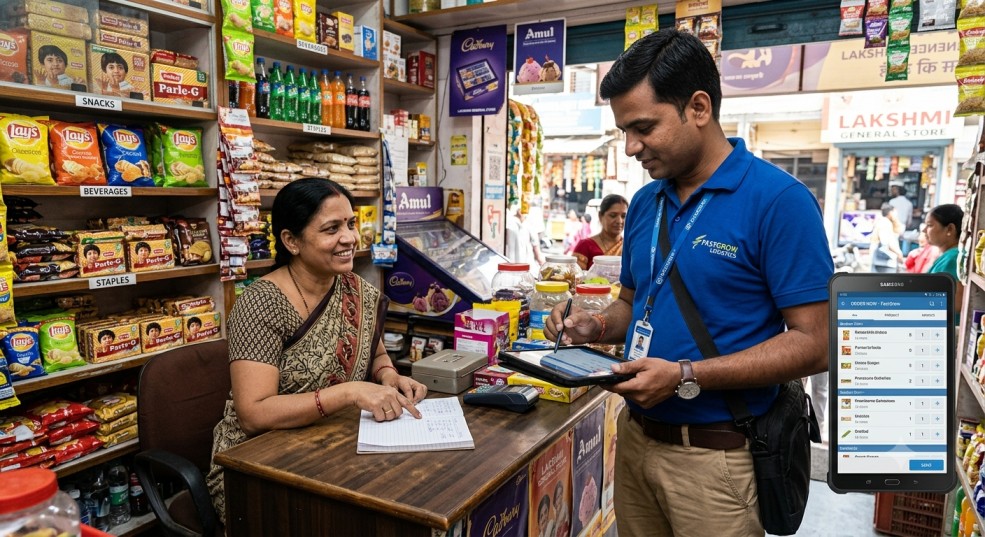
An SFA app can help managers create beat plans and assign specific outlets to sales representatives. Representatives can access their daily schedules through their mobile devices and record visits during field activities.
Better outlet coverage means sales teams can maintain regular engagement with retailers and identify opportunities to generate additional orders.
Manual order collection can slow down the secondary sales process.
With a field sales app, representatives can capture retailer orders directly from the outlet. Product catalogs, pricing, quantities, and order information can be recorded digitally.
Instead of collecting handwritten orders and entering them later, sales teams can submit order information through the SFA platform.
This can reduce manual work and improve the speed and accuracy of order processing.
Traditional reporting methods can make it difficult for managers to understand what is happening across different territories.
Sales Force Automation Software can centralize information about retailer visits, orders, sales representatives, products, and distributors.
Managers can use dashboards and reports to analyze secondary sales by territory, representative, outlet, distributor, product, or time period.
This gives businesses a more structured view of sales performance across their distribution network.
FMCG representatives often manage large numbers of outlets across different locations. Poor route planning can result in missed visits and inefficient use of field time.
SFA software can help managers create structured beat plans based on outlet locations, visit frequency, territories, and sales priorities.
Route optimization can also help representatives organize their daily journeys more efficiently.
Consistent beat execution can contribute to better retailer coverage and more regular order opportunities.
Secondary sales depend heavily on coordination between distributors, sales representatives, and retailers.
A centralized SFA platform can maintain retailer and distributor information in one system. Sales teams can access relevant customer details, previous orders, payment information, and sales history while visiting outlets.
This helps representatives have better context when interacting with retailers and planning their sales activities.
FMCG managers need to know whether planned sales activities are actually being executed.
With GPS-based field tracking, managers can monitor sales representative locations, outlet visits, and daily activities through the SFA platform.
This visibility helps managers compare planned visits with completed visits and identify gaps in field execution.
It can also help managers respond more quickly when important outlets are missed.
Secondary sales are not only about generating orders. Payment collection is another important part of distributor and retailer operations.
Sales Force Automation Software can allow representatives to record collections and monitor outstanding payments during their outlet visits.
When payment information is connected with customer and sales data, managers can get better visibility into receivables and collection activities.
Sales data can reveal patterns that are difficult to identify through manual reporting.
For example, analytics may show that a particular retailer regularly purchases certain products but has stopped ordering another product category.
Sales teams can use these insights to plan follow-ups, recommend relevant products, and identify cross-selling or upselling opportunities.
AI-powered SFA capabilities can further support sales representatives by providing recommendations based on customer and sales patterns.
FMCG businesses often have multiple sales representatives working across different territories.
SFA dashboards can help managers monitor metrics such as outlet visits, order value, sales achievement, productive calls, collection performance, and target progress.
Instead of waiting for end-of-day or manually prepared reports, managers can access centralized information and take action based on current sales activity.
Perhaps the biggest advantage of Sales Force Automation is that it connects multiple field-sales activities within one platform.
Beat planning, outlet visits, order taking, distributor management, payment collection, sales reporting, and analytics can work together instead of operating as separate processes.
This creates a more connected workflow between the field sales team, distributors, retailers, and management.
Secondary sales are critical to FMCG distribution because they provide visibility into how products move from distributors to the retail market.
However, managing secondary sales across a large and distributed network can become difficult with manual processes.
Sales Force Automation Software helps FMCG companies digitize important field-sales activities, including beat planning, outlet management, mobile order taking, field tracking, payment collection, and sales analytics.
By bringing these activities together through an integrated SFA platform, FMCG businesses can gain better visibility into their sales network, improve field execution, and identify opportunities across their retailer and distributor base.
For FMCG companies looking to build a more connected and data-driven field sales operation, Sales Force Automation can become an important part of their digital sales strategy.
#salesforceautomation #sfasoftware #salesforceautomation software