
In today’s rapidly evolving industrial landscape, piping systems play a critical role in ensuring safe, efficient, and uninterrupted operations. From chemical processing plants to water treatment facilities and large-scale infrastructure projects, the choice of pipe fittings directly impacts system reliability and long-term performance. Among the various material options available, UPVC pipe fittings have emerged as the preferred choice for industrial buyers worldwide due to their durability, corrosion resistance, cost efficiency, and proven performance across diverse applications.
This blog explores why UPVC pipe fittings continue to gain global acceptance and why industrial buyers trust them for both standard and mission-critical piping systems.
UPVC (Unplasticized Polyvinyl Chloride) is a rigid thermoplastic material widely used in industrial piping systems. Unlike plasticized PVC, UPVC does not contain added plasticizers, making it stronger, more chemically resistant, and suitable for demanding industrial environments.
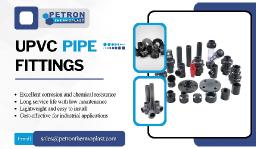
UPVC pipe fittings include a wide range of components such as elbows, tees, reducers, couplers, unions, flanges, crosses, and adaptors. These fittings are designed to create leak-free, reliable connections in pipelines carrying water, chemicals, and other industrial fluids.
One of the biggest reasons for the global popularity of UPVC pipe fittings is their outstanding resistance to corrosion. Unlike metal fittings, UPVC does not rust, oxidize, or degrade when exposed to moisture, chemicals, or aggressive environments.
Industrial buyers operating in chemical plants, electroplating units, and wastewater treatment facilities rely on UPVC fittings to handle acids, alkalis, salts, and corrosive fluids without compromising performance. This corrosion resistance significantly extends system life and reduces replacement costs.
UPVC pipe fittings are known for their long operational life, even under continuous-duty conditions. When properly installed, UPVC systems can last for decades with minimal maintenance.
For industrial buyers managing large-scale facilities, low maintenance requirements translate into:
This makes UPVC fittings a cost-effective solution over the entire lifecycle of an industrial piping system.
Cost is a key consideration for industrial buyers, especially for large infrastructure and EPC projects. UPVC pipe fittings offer an excellent balance between performance and affordability.
Compared to metal or specialty polymer alternatives, UPVC fittings are:
These advantages make UPVC pipe fittings a preferred option for projects requiring both quality and budget control.
UPVC pipe fittings are significantly lighter than metal fittings, which simplifies handling and installation on-site. This is particularly beneficial for large industrial projects where thousands of fittings may be installed.
Key installation benefits include:
Industrial buyers value UPVC fittings for helping projects stay on schedule without compromising installation quality.
Despite being lightweight, UPVC pipe fittings offer excellent mechanical strength. They are designed to withstand internal pressure, external loads, and mechanical stress commonly encountered in industrial environments.
High-quality UPVC fittings are manufactured with precise dimensions and uniform wall thickness, ensuring:
This makes them suitable for both utility lines and process pipelines.
UPVC pipe fittings are used across multiple industries, which further strengthens their global acceptance.
Chemical & Process Industries
UPVC fittings are ideal for transporting corrosive chemicals, process water, and treatment solutions. Their chemical resistance and leak-free performance make them a trusted choice for process plants.
Water & Wastewater Treatment
From raw water intake to effluent discharge, UPVC pipe fittings support efficient fluid handling in water treatment plants, desalination facilities, and sewage systems.
Power Plants & Utilities
UPVC fittings are commonly used in cooling water lines, utility pipelines, and chemical dosing systems within power generation facilities.
Infrastructure & EPC Projects
EPC contractors worldwide prefer UPVC pipe fittings for infrastructure and industrial construction projects due to ease of installation, consistency, and long-term reliability.
Global Standards and Quality Compliance
Industrial buyers worldwide look for products that comply with international quality standards. Reputable manufacturers produce UPVC pipe fittings that meet recognized norms such as:
These standards ensure dimensional accuracy, pressure rating compliance, and material consistency—critical factors for global buyers working on export and multinational projects.
Leak-Free Performance and System Safety
Leakage in industrial piping systems can result in production loss, safety hazards, and environmental damage. UPVC pipe fittings are designed to provide secure and leak-proof joints when installed correctly.
Solvent cement joints create a strong chemical bond, while threaded and flanged connections offer flexibility for maintenance and system expansion. This reliability enhances overall system safety and buyer confidence.
Sustainability and Environmental Benefits
Sustainability is becoming increasingly important for industrial buyers worldwide. UPVC pipe fittings support environmentally responsible operations by offering:
By choosing UPVC, industries contribute to reduced resource consumption and more sustainable infrastructure development.
While UPVC as a material offers many advantages, the quality of manufacturing plays a crucial role in performance. Global industrial buyers prefer sourcing UPVC pipe fittings from experienced manufacturers who provide:
Partnering with a trusted manufacturer ensures that fittings perform as expected across different operating conditions and project scales.
UPVC pipe fittings continue to see growing demand in regions such as the Middle East, Africa, Southeast Asia, and Europe. Rapid industrialization, infrastructure expansion, and water management projects have driven the need for reliable and cost-effective piping solutions.
Industrial buyers in these regions value UPVC fittings for their adaptability to harsh climates, chemical exposure, and continuous operation requirements.
The global preference for UPVC pipe fittings is driven by a combination of performance, durability, cost efficiency, and versatility. From chemical processing plants to large infrastructure projects, Petron Thermoplast deliver reliable service while helping industrial buyers control costs and minimize maintenance.
As industries worldwide continue to expand and modernize their piping networks, UPVC pipe fittings remain a trusted and proven solution. By choosing high-quality fittings from experienced manufacturers, industrial buyers can ensure safe, efficient, and long-lasting piping systems that meet both current and future operational demands.
| No comments yet. Be the first. |
