
Effluent Treatment Plants (ETPs) play a critical role in managing industrial wastewater before it is discharged or reused. These plants handle a wide range of corrosive, chemically aggressive, and contaminated fluids, making the selection of piping materials a vital engineering decision. Among various piping solutions available today, industrial UPVC pipe fittings have emerged as a reliable and cost-effective choice for effluent treatment systems.
This blog explores why UPVC pipe fittings are widely preferred in effluent treatment plants, their advantages over conventional materials, and how they contribute to safe, efficient, and long-term plant operations.
Effluent treatment plants are exposed to harsh operating conditions, including:
Traditional metal fittings often fail in such environments due to corrosion, scaling, leakage, and frequent maintenance requirements. This has driven industries to adopt UPVC (Unplasticized Polyvinyl Chloride) pipe fittings as a corrosion-resistant alternative.
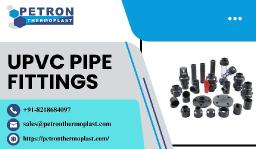
UPVC pipe fittings are rigid thermoplastic components used to connect, redirect, or control fluid flow in piping systems. Unlike metal fittings, UPVC does not corrode, rust, or react with most industrial chemicals.
Common UPVC fittings used in ETPs include:
These fittings are designed to ensure leak-free joints, smooth flow, and long-term reliability.
Effluent streams often contain a mix of acids, alkalis, salts, and chemical residues. UPVC pipe fittings offer outstanding resistance to these substances, preventing corrosion-related failures common in metal systems.
This makes UPVC fittings suitable for both primary treatment and secondary treatment pipelines.
UPVC fittings are compatible with a wide range of chemicals used in effluent treatment, including:
Their chemical inertness ensures consistent performance without material degradation.
Leakage in effluent treatment systems can lead to environmental hazards and operational inefficiencies. UPVC pipe fittings are precision-molded to ensure:
This reliability is critical for continuous plant operation.
UPVC fittings are significantly lighter than metal fittings, offering several benefits:
This is especially advantageous for large-scale ETP installations and retrofit projects.
The smooth bore of UPVC fittings minimizes friction losses and prevents the buildup of sludge and deposits. This helps in:
Since UPVC does not rust or scale, maintenance requirements are minimal. Benefits include:
For ETP operators, this translates into lower operating costs over the system’s lifecycle.
Compared to stainless steel or special alloy fittings, UPVC pipe fittings offer:
This makes UPVC an economically attractive option for both new ETP projects and system upgrades.
UPVC fittings are used across various sections of an effluent treatment plant, including:
Their versatility allows them to support multiple treatment stages efficiently.
|
Parameter |
UPVC Pipe Fittings |
Metal Fittings |
|
Corrosion Resistance |
Excellent |
Poor to Moderate |
|
Weight |
Lightweight |
Heavy |
|
Maintenance |
Low |
High |
|
Chemical Compatibility |
High |
Limited |
|
Service Life |
Long |
Shorter |
|
Lifecycle Cost |
Low |
High |
This comparison clearly highlights why UPVC pipe fittings are preferred in effluent treatment applications.
Compliance with Industrial Standards
Industrial UPVC pipe fittings are manufactured in accordance with international quality and performance standards, ensuring reliability in demanding applications. This makes them suitable for:
At Petron Thermoplast, we offer a comprehensive range of industrial UPVC pipe fittings engineered for effluent treatment applications. Our fittings are designed to deliver:
We support EPC contractors, OEMs, and industrial operators with dependable piping solutions.
By choosing UPVC pipe fittings, effluent treatment plants benefit from:
These advantages align with modern environmental compliance and sustainability goals.
Effluent treatment plants require piping systems that can withstand harsh chemicals, continuous operation, and demanding environmental conditions. Industrial UPVC pipe fittings by Petron Thermoplast offer an ideal combination of corrosion resistance, cost efficiency, ease of installation, and long service life. For industries looking to build or upgrade reliable effluent treatment systems, UPVC pipe fittings provide a safe, economical, and future-ready solution.
| No comments yet. Be the first. |
