


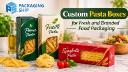
Custom pasta boxes protect fresh and dry pasta while giving your brand a clear spot on the shelf. The right box is food-safe, fits the pasta shape, and keeps moisture and crushing from spoiling the product. You can see pasta packaging options on the custom pasta boxes page at Packaging Ship, and this guide explains what to check before you choose.
Custom pasta boxes are paperboard food containers built to your pasta's size and printed with your branding. They're used for dry pasta like spaghetti and penne, and for fresh pasta like ravioli, fettuccine, and gnocchi.
A typical box includes:
Pasta makers, delis, farmers market vendors, Italian restaurants, and gourmet food brands all use them.
Pasta is fragile, and each shape needs different support. Long strands snap in a loose box, and filled pasta can squash. A box built around the product protects it far better than a stock carton.
Dry pasta needs a sturdy, dry-safe box, while fresh pasta needs moisture control and usually refrigeration. That one difference changes the board, the lining, and the shelf life you can expect.
| Feature | Dry Pasta Box | Fresh Pasta Box |
|---|---|---|
| Moisture needs | Keep dry | Handle condensation and dampness |
| Typical board | Food-grade SBS paperboard or kraft | Coated or lined board, sometimes with a tray |
| Barrier | Usually none or a light coating | Aqueous coating or PE lining |
| Storage | Pantry | Refrigerated or frozen |
| Main risk | Breakage, pests | Sogginess, leaks, spoilage |
Fresh pasta releases moisture and a little oil, which weakens plain board. Two common fixes are an aqueous coating and a PE (polyethylene) lining. An aqueous coating is water-based and adds light resistance to moisture and scuffing, while a PE lining gives a stronger barrier but can make recycling harder. Ask your supplier which one suits your storage conditions, and test a sample with real pasta before you order in bulk.
Food-grade paperboard and kraft are the most common choices. The board's thickness is measured in points (pt), where 1 pt equals 0.001 inch, and most folding cartons for food fall somewhere between 14 pt and 24 pt.
| Material | Typical Thickness | Best For | Look |
|---|---|---|---|
| SBS paperboard (solid bleached sulfate) | 14–24 pt | Dry pasta, bright and detailed printing | Clean, white, polished |
| Kraft board | 14–24 pt | Artisan and farm-to-table brands | Natural, rustic |
| Coated or lined board | Varies | Fresh and filled pasta | Smooth, protective |
| Rigid gift box | Heavier board | Pasta gift sets with sauce or olive oil | Premium |
A lighter board, around 14 to 16 pt, works for small dry-pasta cartons. Longer boxes and heavier portions do better with 18 pt or more, since thin board bows under weight.
Most pasta windows use a clear PET film, which is a food-safe plastic that is lightweight and see-through. Some brands choose PLA film, a plant-based material that is marketed as compostable, but it generally needs an industrial composting facility to break down. Whichever you pick, ask what the film is made of, and be careful about recycling or compostability claims, since the FTC's Green Guides require accurate wording.
Everything that touches food must use materials approved for food contact. The FDA regulates food-contact materials in the United States, so ask your supplier to confirm that the board, coating, liner, inks, and film are suitable for food use. A written food-contact statement from the supplier is a reasonable thing to request.
Before you order, check these points:
If you sell at farmers markets or online, your local health authority can tell you what the label must include.
Pick a size that holds the pasta firmly without letting it shift. For long pasta like spaghetti, measure the strand length and add about half an inch. For short shapes, size by weight, then check the fit with real pasta.
To work out your size:
A snug box also looks better on a shelf, since a half-empty one suggests the customer is paying for air.
Packaging helps a pasta brand stand out by being easy to recognize, easy to read, and nice to hold. On a crowded deli or grocery shelf, the box is often the first thing a shopper notices.
Ways to build your brand on the box:
Gift buyers also respond well to a ribbon, an embossed logo, or a custom insert that holds a sauce jar next to the pasta.
Custom pasta boxes often cost between $0.30 and $2.00 each, depending on size, board, window, lining, printing, and quantity. Simple printed cartons sit at the low end, while rigid gift boxes and lined fresh pasta packaging cost more.
| Cost Factor | Effect on Price |
|---|---|
| Order quantity | Higher volume lowers the price per box |
| Board type and thickness | Thicker or coated board costs more |
| Window film | Adds a small cost per box |
| Liner or tray | Adds material cost |
| Printing and finishes | Full color and foil cost more than one color |
| Shipping | Free shipping lowers your total |
Ask for the full delivered price, since freight and setup fees can change what you really pay.
Packaging Ship is a US-based custom packaging company in Valley Stream, New York, that produces food packaging along with mailer boxes, rigid boxes, tuck boxes, cosmetic boxes, and mylar bags. A few things matter to pasta businesses in particular:
Before placing an order, ask about food-contact compliance, available board thicknesses, coating options, and samples, so you know the box suits your pasta.
Can I print the nutrition label directly on the box?Yes, many brands print the nutrition facts, ingredients, and allergen information directly on the box, which looks cleaner than a sticker. Have the layout checked against current FDA labeling rules before you approve the proof.
Is one-color printing cheaper than full color?Usually yes. A single-color logo on kraft board is typically the lowest-cost way to get a branded look, while full color and foil add to the price.
What is the minimum order quantity for custom pasta boxes?It varies by supplier, and many start somewhere between 100 and 500 boxes for custom printed food packaging. Confirm the exact number before you finalize your design.
How long does it take to get custom pasta boxes?Production and shipping usually take two to four weeks, depending on quantity and finishes. Rush options may be available for an extra fee.
Are paper pasta boxes recyclable?Plain paperboard usually is, but plastic windows, PE linings, and heavy coatings can limit recycling in some areas. Ask your supplier about the materials, and check local recycling rules before you add a recyclable claim.
Can I ship fresh pasta in a paper box?Yes, with an insulated outer shipper and a cold pack for fresh pasta, plus a lined inner box to handle moisture. Dry pasta ships easily in a sturdy carton inside a corrugated mailer.
How do I get a sample before ordering?Ask your supplier whether a physical sample or a digital proof is available before production. Test it with your actual pasta, at your normal storage temperature, for a few days.
A well-made pasta box protects your product, meets food-safety needs, and makes your brand easy to spot. Send Packaging Ship your pasta type, box size, and quantity through the custom pasta boxes page, ask about samples and coating options, and get a quote based on your real specs, so you can plan your next production run with confidence.