
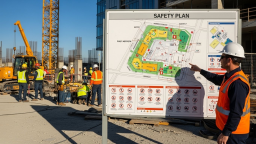
A safety plan in construction is a comprehensive document designed to identify the risks of hazards, provide safety procedures, and define guidelines that shall be followed to secure workers, contractors, and other people visiting a construction site. The construction work is also considered risky because of heavy machinery, heights, electricity, dangerous materials, and activities taking place on the site.
An effective safety plan guarantees that the legal regulations are adhered to, there is minimized risk of accidents, and there is also a safety culture among the entire staff. It contains risk assessments and emergency procedures, personal protective equipment (PPE), and training protocol. The adoption of a safety plan is not only a government regulation but a strategic way of saving lives, reducing the time taken in projects, and containing the cost of accidents related to the workplace.
Building sites are highly dynamic and often hazardous environments. Without proper safety planning, the risk of accidents, injuries, and fatalities increases significantly. To reduce these risks, many contractors now collaborate with industry professionals who provide detailed estimating services and material takeoffs. By working with construction estimating consultants, contractors can align safety requirements with accurate cost estimates and project timelines, ensuring that protective measures, labor needs, and materials are properly planned from the pre-construction stage.
A safety plan is essential for the following reasons:
Legal Conformity: Government agencies like OSHA (Occupational Safety and Health Administration) insist that construction firms should have safety measures in place. Failure to comply may lead to a fine, closure of the project, or even a lawsuit.
Protection of the Workers: The first thing is the safety of the workers. A plan will include the procedures that need to be adopted to safeguard employees against risks such as falls, electricity, exposure to chemicals, and machinery accidents.
Project Continuity: Accidents cause time wastage, loss of money, and time. A safety plan minimizes the risks of occurrence, and thus, projects are completed on time.
Financial Efficiency: Accidents in the workplace can be covered by insurance, medical expenses, as well as litigation. The safety planning reduces such costs through prevention.
Cultural Benefits: The work environment is safe, and this creates trust, morale, and productivity among workers.
A comprehensive safety program addresses several areas of the construction activities. Key components include:
The initial step in a safety plan is to identify the hazards. The risks might involve working at heights, working on heavy machinery, contact with chemicals, electrical, noise, and the environment. The scheme ought to prioritize hazards by severity and probability so that the teams can prioritize the safety measures.
There is a set of clear policies that regulate the behavior of workers and define expectations. Examples include:
Emergency protocols should be outlined in the safety plan, and they include:
Employees need to be conditioned on how to observe safety precautions. Training may cover:
The list of necessary PPE related to various tasks will guarantee sufficient protection of workers. The safety plan must identify the requirements of PPE, inspection schedules, and timelines.
Ongoing observations are done to ensure adherence to the safety plan. Corrective actions, near misses, and unsafe practices should be noted by site supervisors.
Risks and procedures can be known to everyone due to efficient communication. The use of safety meetings, signs, manuals, and online alerts can spread the information effectively.
Making records of the incidents, hazards, inspections, and training is crucial. Compliance audits are supported by documentation, the patterns can be identified, and the needed proof can be furnished, either legally or by insurance.
Types of Safety Plans
The safety plans can be different according to the project size, complexity, and the regulatory needs. Common types include:
Construction Safety Plan Development
To develop a proper safety plan, it is possible to take many steps:
Benefits of Adopting a Safety Plan
In construction, a safety plan is a very important document that safeguards the workers, compliance, and efficiency in the project. The construction companies can minimize accidents and the related costs through the identification of hazards, setting up clear procedures, training, and surveillance of adherence. Safety plans must be location-specific, frequently revised, and reformulated to indicate variations in the scope of the project or rules. In addition to regulatory compliance, a good safety culture fosters productivity, employee morale, and a good reputation for the company. Regardless of whether the project is a small residential construction or a big commercial location, the introduction of an elaborate safety plan is the key to a successful and risk-free construction project.
What is the main purpose of a construction safety plan?
The primary one is to preserve the safety of workers and visitors of the site by means of risk detection, safety measures, and adherence to safety rules.
Who is responsible for a construction safety plan?
Normally, developing, implementing, and monitoring the safety plan is done by project managers, safety officers, and site supervisors.
How often should a construction safety plan be updated?
A safety plan should be reviewed and updated regularly, especially when project conditions change, new hazards are identified, or after any accidents or near misses.
| No comments yet. Be the first. |