Parts are not just expensive anymore. They are unpredictable. Interest rates are not just high. They are squeezing every capital decision you make. So here is the uncomfortable question: Can you really afford to run your fleet the same way you did two years ago?
Most operators are still stuck in a break-fix loop. Something fails. You repair it. You move on. It feels practical. It feels efficient. It is neither.
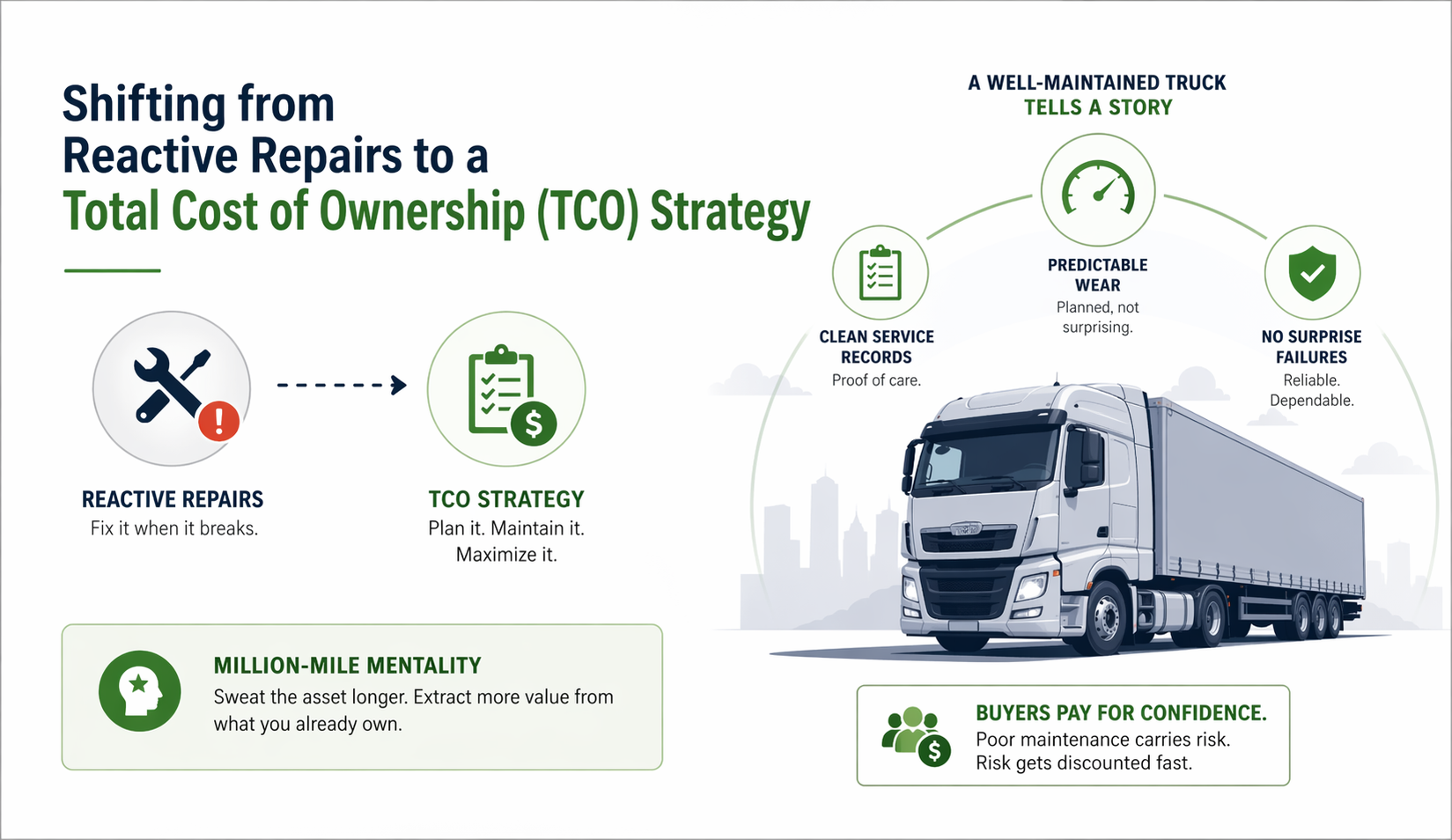
The smarter shift is already happening. It is called Total Cost of Ownership (TCO). And it changes everything. Instead of asking “What did this repair cost?” you start asking “What is this vehicle costing me over its entire life?” That is where fleet maintenance services stop being a cost center and start becoming a profit strategy.
There is a quiet mindset shift happening inside high-performing fleets. Call it the million-mile mentality. The goal is simple: Sweat the asset longer. Extract more value from what you already own instead of buying new at inflated prices.
That only works if your commercial fleet maintenance is disciplined. Not occasional. Not reactive. Disciplined.
Think about resale value for a moment. A well-maintained truck tells a story:
Clean service records.
Predictable wear.
No surprise failures.
Buyers pay for that confidence. On the other hand, a poorly maintained vehicle carries risk. And risk gets discounted fast. Are you maintaining trucks just to keep them running? Or are you maintaining them to maximize their lifetime value?
Let’s talk about the number nobody wants to calculate. The invoice says ₹40,000 for a repair. That feels like the cost. It is not even close.
Downtime is where the real damage happens. According to a CerebrumX Fleet Downtime Analysis, unplanned downtime costs between $448 and $760 per day, per vehicle. Now multiply that across your fleet. Across a month. Across a year.
Suddenly, your fleet repair and maintenance strategy looks very different. That one breakdown did not just cost you parts and labor. It costs:
Missed deliveries.
Idle drivers.
Unhappy customers.
Lost future contracts.
These are the leaks that quietly sink profitability.
Here is where most fleets get it wrong. They treat maintenance like a calendar event. Every 5,000 miles. Every 10,000 miles. Same checklist. Same routine.
But your fleet is not uniform. A city delivery van lives a completely different life from a long-haul truck. Stop-start traffic, constant braking, and extended idling create a different kind of wear. This is where fleet maintenance professionals make a real difference. They shift maintenance from generic schedules to usage-based logic.
Instead of asking “When was the last service?” you ask “How has this vehicle actually been used?” That one change reduces unnecessary servicing on some vehicles and prevents catastrophic failures in others. It’s about doing the right maintenance at the right time.
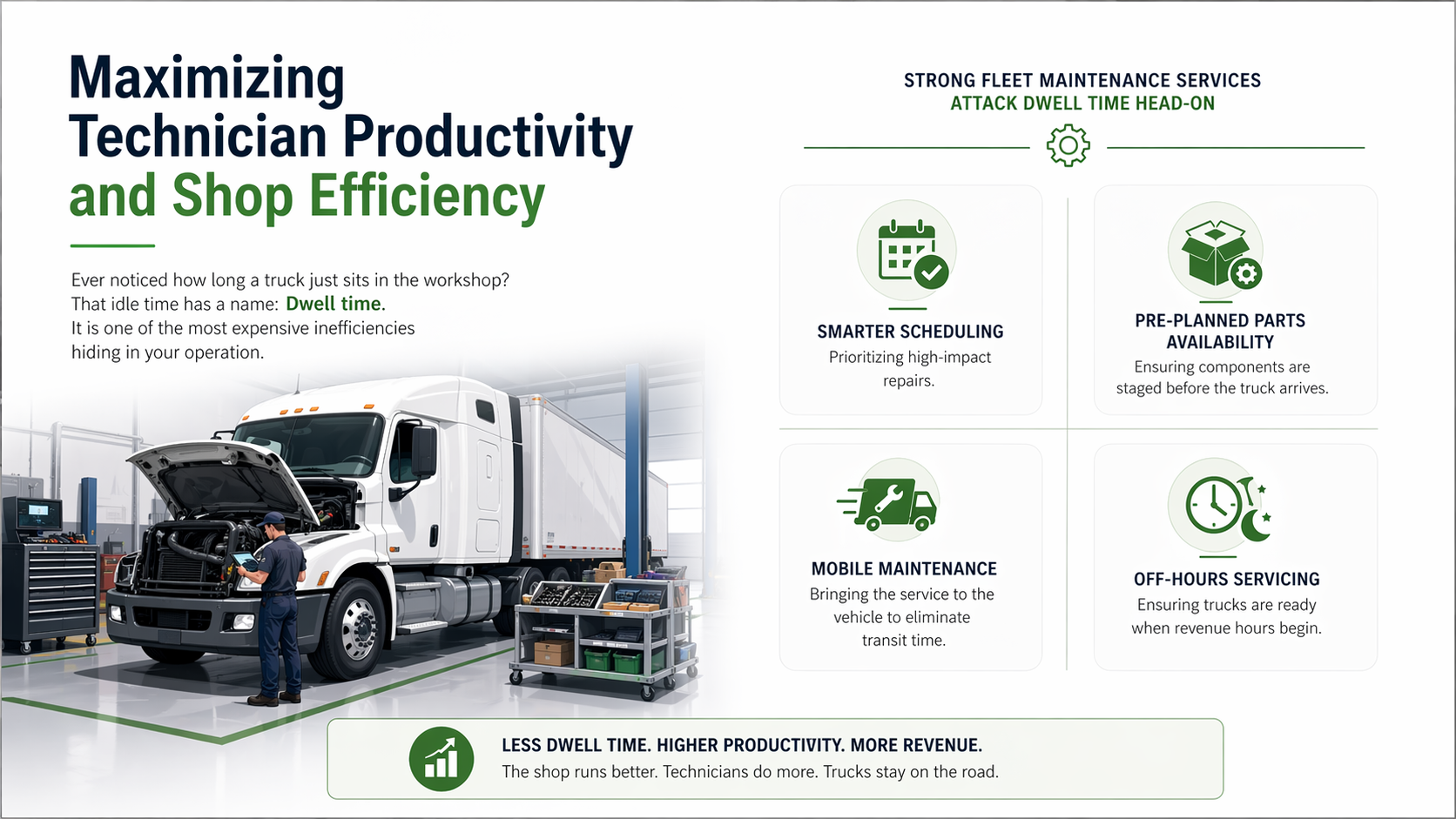
Ever noticed how long a truck just sits in the workshop? That idle time has a name: Dwell time. It is one of the most expensive inefficiencies hiding in your operation.
Strong fleet maintenance services attack this problem head-on through:
Smarter scheduling: Prioritizing high-impact repairs.
Pre-planned parts availability: Ensuring components are staged before the truck arrives.
Mobile maintenance: Bringing the service to the vehicle to eliminate transit time.
Off-hours servicing: Ensuring trucks are ready when revenue hours begin.
Reactive maintenance feels urgent, but it is also expensive. Data from Oxmaint shows that reactive repairs cost three to five times more than planned preventive work. Every time you delay maintenance, you are essentially signing up for the "reactive maintenance tax."
Effective fleet repair services prioritize planned interventions over emergency fixes to stabilize costs and keep your fleet predictable. In logistics, predictability is power.
Your drivers are your earliest warning system. They hear the unusual noise; they feel the braking difference. Without structure, those observations get lost.
Digital pre-trip inspections turn driver observations into actionable data. A minor crack spotted today could prevent a ₹40 lakh engine failure tomorrow. This only works if there is a culture shift: maintenance is not just the mechanic’s job, it is everyone’s responsibility.
The fleets that win in 2026 will not rely on luck. They will rely on systems, think in terms of Total Cost of Ownership, replace reactive habits with preventive discipline, and optimize every minute of technician time. Ultimately, they will turn drivers into active participants in maintenance.
That is how profitability is built today.
And this is exactly where Kooner Fleet Management Solutions stands out as a partner. With a deep understanding of real-world fleet challenges, Kooner helps businesses move beyond patchwork fixes and build structured, high-performance maintenance ecosystems that scale.
If you are serious about reducing downtime, controlling costs, and extending vehicle life, the next step is simple.
Stop fixing problems. Start preventing them. Partner with Kooner and take control of your fleet before your costs take control of you.
| No comments yet. Be the first. |