



For small practices in the United States, outsourcing billing can ease pressure on a lean team. But handing off work should not mean losing sight of claim status, payments, or unresolved denials. Before choosing a partner, practices need to understand how they will review billing activity and raise issues that need attention.
Healthcare revenue cycle management (RCM) covers the administrative work involved in getting paid for care, from eligibility checks and coding through claims, payment posting, and follow-up. Outsourcing some or all of that work may help practices focus staff time on patients and billing tasks. The key is to agree on reporting, system access, and decision-making before the handoff begins.
Outsourcing changes who performs billing tasks, not the practice’s need to oversee its revenue. Clinicians and practice leaders still need a dependable way to check whether claims were submitted, see what payers have paid, and identify accounts that need follow-up. A vendor’s general assurance that it provides “visibility” is not enough. Ask what information your team can actually see and how often it is updated.
Start by mapping the work you plan to transfer. A practice may outsource claim submission and denial follow-up while keeping eligibility verification or patient statements in-house. The exact scope matters because reporting should match the tasks assigned. If a vendor handles coding, for example, ask how coding questions are flagged and who at the practice approves changes when needed.
Outsourced RCM can support cash flow, denial work, and time for patient care, but those benefits depend on clear responsibilities and routine review. Before signing, write down who handles each step, what the practice retains, and which decisions require provider or manager input. This simple division helps prevent missed work and confusion when a claim needs attention.
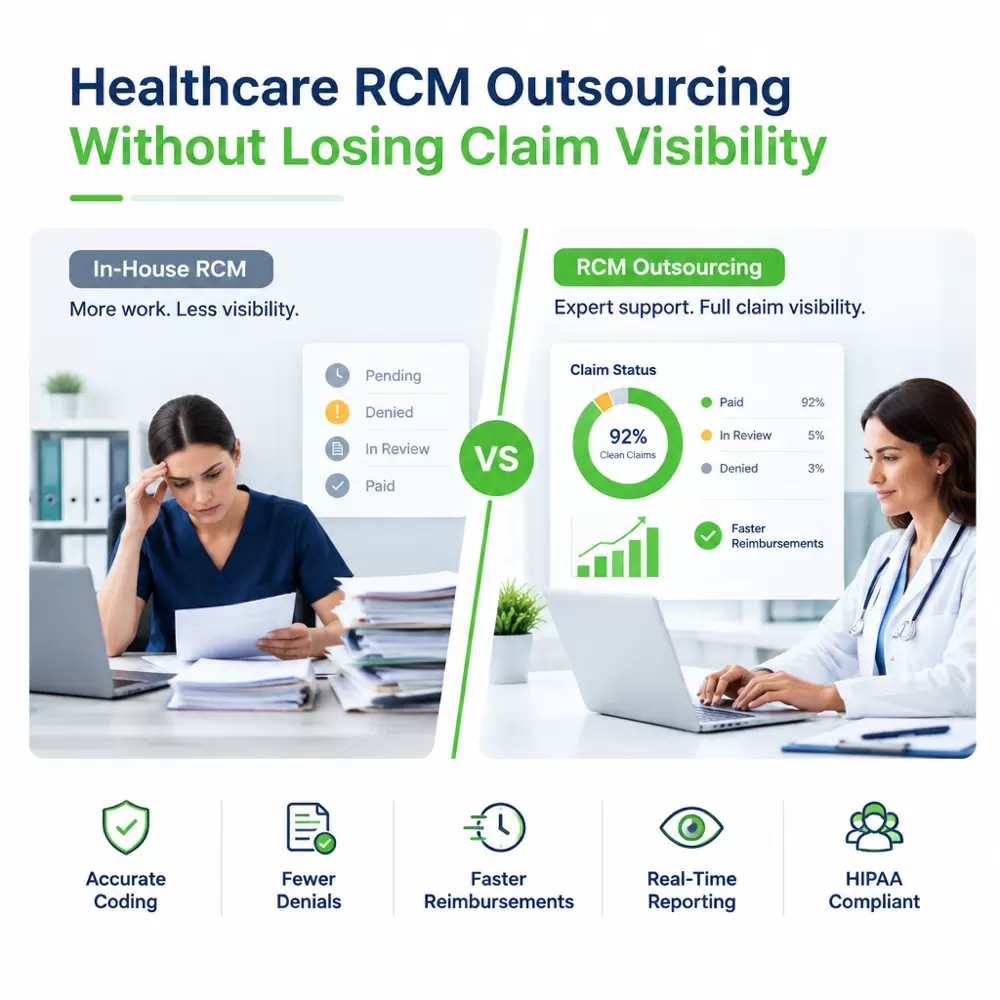
Ask a prospective partner to walk through a routine review using the reports or tools it expects your team to use. Do not assume that a dashboard is included, or that it will show the detail your practice needs. Find out whether staff can view individual claim status, payment details, denial reasons, aging accounts, and work still awaiting action. Confirm what the system considers current, and whether updates happen in real time or on a set schedule.
Set a reporting cadence that fits your practice. A small clinic may need a regular summary of claims awaiting action and payments posted, plus a scheduled meeting to review older issues. Ask who prepares each report, who receives it, and what happens when the report is late or contains a discrepancy. Also clarify whether your team can request a report outside the usual schedule when a specific payer or account needs review.
For a broader look at how outsourced RCM can support practices, clinics, and hospitals, review outsourcing revenue cycle management healthcare. Use that discussion as a starting point, then ask each vendor to explain how its proposed service scope, reports, and review process would apply to your own practice.
Data access deserves specific questions, too. Ask who owns the billing records and how the practice can retrieve them during the contract and after it ends. Confirm which staff can access the system, whether access can be limited by role, and how access is removed when an employee leaves or responsibilities change. Request clear instructions for exporting records if the relationship ends, including the format and any transition steps the practice must complete.
Because billing records can include sensitive patient information, review the vendor agreement and privacy responsibilities with the appropriate internal lead or legal adviser. Ask what written agreements and safeguards apply to the proposed work. Avoid relying on broad assurances alone. The practice should understand its responsibilities, the vendor’s responsibilities, and how concerns are reported and addressed.
Good reporting only helps when someone acts on it. During vendor discussions, ask how the practice should escalate a time-sensitive claim issue, a suspected coding concern, or a pattern of denials. Get the names or roles of the contacts responsible for routine questions and urgent ones. Ask what response process the vendor follows, and how unresolved items are tracked until they are closed.
Use these questions to compare providers on operational fit:
Be wary of choosing based only on a low fee or a broad promise to improve collections. A proposal should spell out the services, reporting expectations, responsibilities, and any work that falls outside the agreement. If answers about data ownership or access are vague, ask for clarification in writing before sharing information or transferring workflows.
Once you select a partner, establish a baseline for the measures that matter to your practice and review them on a consistent schedule. For example, agree on how to identify claims awaiting follow-up and how to verify that payments have been posted accurately. Keep an internal owner responsible for reviewing reports and bringing open questions to the vendor. This does not require the practice to redo every billing task. It keeps oversight connected to the work.
Healthcare RCM outsourcing works best when the practice can see what is happening, understand who owns each task, and reach the right person when a problem arises. Define those expectations before contracting, test the reporting process during onboarding, and revisit it as the practice’s needs change. For advice on contract terms, privacy duties, or billing compliance, consult qualified legal or compliance professionals familiar with your situation.
| No comments yet. Be the first. |
