


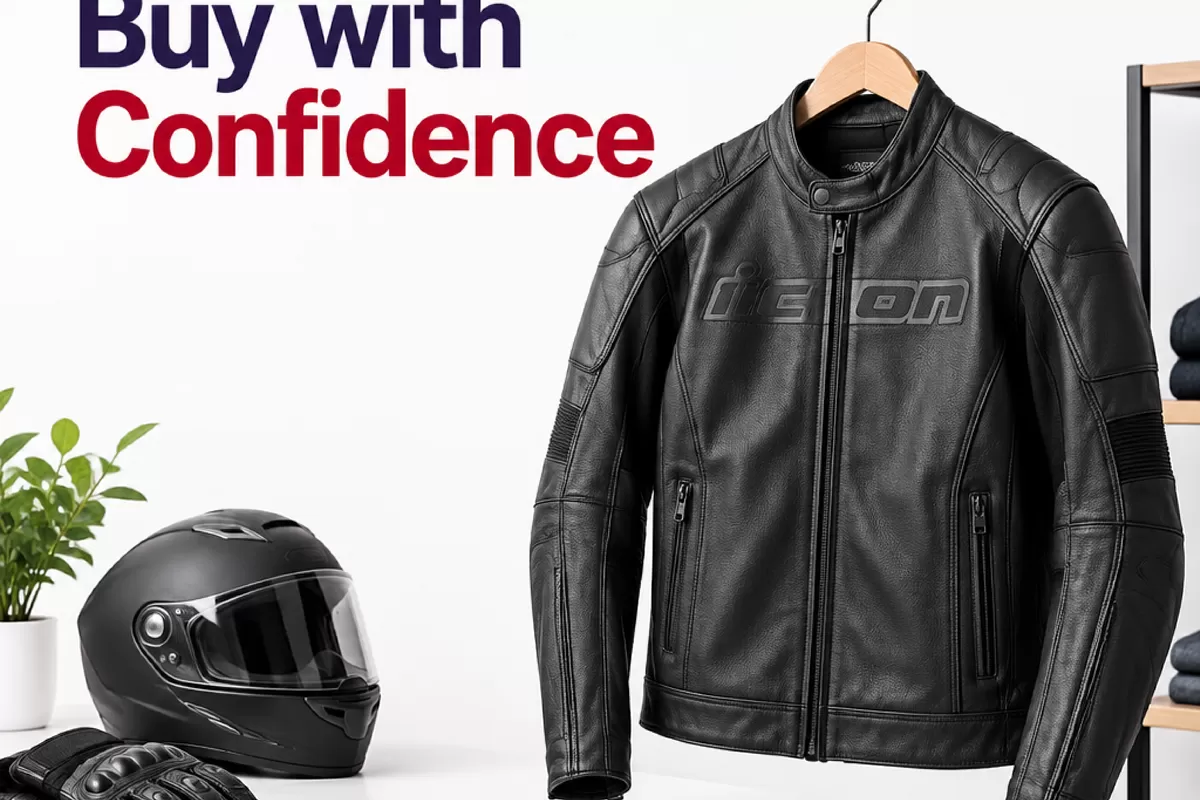
Buying an Icon Motorhead leather jacket can take more checking than a listing’s title and a few product photos suggest. In the United States, buyers may be comparing retailer pages with resale listings, and details can vary by seller. Before committing, verify the exact model and generation, look closely at the condition, and get fit and feature information tied to that specific jacket.
This checklist is useful whether the jacket is described as new, used, or simply available for purchase. It does not assume a particular version is in stock or that every model has the same materials, fit, protective components, or liner. Treat each listing as a set of claims to confirm, not as proof by itself.
Start by asking the seller to identify the jacket beyond the words “Icon Motorhead.” A model name can be used loosely in a listing, and photographs may not show enough detail to distinguish one version from another. Look for a full model name, product code, label, or other identifier that can be checked against product documentation. If the listing gives only a broad name, ask for a clear photo of the inside label and any tags that remain with the jacket.
Compare that information with the jacket shown in the listing. Pay attention to visible design details, such as the placement and shape of panels, closures, pockets, and logos. These observations can help you spot a mismatch, but they do not establish the generation on their own. A seller’s memory or a marketplace category is weaker evidence than a model identifier matched to reliable documentation.
Keep a record of the listing description and any written answers. This makes it easier to compare the item you receive with what was represented, especially when a seller uses broad wording or combines details from more than one version.
For a used jacket, condition is more than whether it looks clean in a wide shot. Ask for recent photos in good light, including the front, back, both sides, cuffs, collar, seams, closures, and interior. Close-ups should show areas that commonly reveal wear, such as stress points, edges, and places where the jacket bends. If a photograph is blurry, heavily edited, or cropped around a questionable area, ask for another view rather than guessing.
Look for cracking, peeling, deep creases, discoloration, loose stitching, damaged closures, and repairs. These signs do not all mean the jacket is unusable, but they can affect appearance, function, and value. Ask the seller to describe any damage or alteration in writing. A phrase such as “good condition” is subjective, so ask what that means for the specific item.
Do not treat a seller’s assurance as a substitute for evidence. If the photos do not show the areas you need to assess, or the answers remain vague, compare another listing or wait for clearer information. A low price cannot make an unknown condition easier to judge.
Fit should be checked against guidance for the exact model, not inferred from the name or from another jacket. Ask for the seller’s model-specific size chart or sizing notes, then compare them with measurements from a jacket you already own that fits the way you prefer. Useful measurements may include chest, shoulder width, sleeve length, and back length. Confirm how the seller measured each point, since measuring a garment flat can differ from measuring around the body.
Consider what you will wear underneath and how you expect the jacket to sit when zipped. A close fit over a T-shirt may feel different over a sweatshirt or other layers. If buying in person is possible, try it on and check comfort while seated and standing. For an online purchase, ask about the return terms before ordering. Do not assume sizing runs small or large unless the seller can point to model-specific guidance.
Protection and liner claims need the same careful approach. Do not assume that a jacket includes armor, a removable liner, a particular certification, or any specific performance feature because another version has it. Ask the seller to identify what is included with this exact item and request documentation that matches its model or generation. If protective components matter to your decision, verify the relevant labels and instructions, and ask a qualified gear retailer or safety specialist if the documentation is unclear.
Use model-specific evidence for model-specific decisions. If the identifier, fit notes, or included-feature details cannot be verified, treat them as unknown rather than filling in the gaps.
Compare listings on evidence as well as price. One seller may provide a model identifier, detailed photos, measurements, and clear return terms, while another may offer little beyond a title. Make a simple side-by-side note of what is confirmed, what is uncertain, and what the seller has agreed to provide. Include shipping costs and return conditions in your comparison, since the lowest listed price may not be the easiest option to evaluate.
If you are comparing an individual listing with a general leather-jacket storefront, Super Leather Shop describes a broader selection of premium jackets for men and women. Its general storefront is not confirmation that this specific model is listed, but it can be another place to review the store’s jacket range: icon motorhead leather jacket.
Before you decide, make sure you can answer four questions: Is this the exact model and generation I want? Do the photos and seller’s answers give a credible picture of its condition? Do I have measurements or sizing guidance for this version? Are the protection and liner details supported by documentation? If any answer is no, ask for the missing evidence. If it is still unavailable, move on rather than relying on assumptions.
That final pause is practical, not picky. A jacket listing should give you enough information to judge the item being offered. Confirm the details first, keep the seller’s answers, and buy only when the remaining unknowns are acceptable to you.
| No comments yet. Be the first. |
