


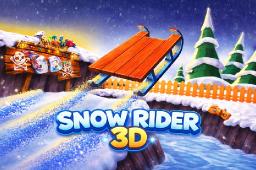
In a world of sprawling open-world epics and complex narratives, sometimes all you crave is a pure, unadulterated burst of adrenaline and focus. For me, that craving is often satisfied by a game called Snow Rider . It’s not going to win any awards for groundbreaking graphics or intricate storylines, but what it offers is a deceptively simple yet utterly captivating experience: an endless downhill sledding adventure built on quick reactions, obstacle avoidance, and the insatiable desire to beat your own high score.
I first stumbled upon Snow Rider a few months ago, probably during a procrastination session that involved endless scrolling. The game’s premise is instantly understandable: you’re on a sled, hurtling down a snowy slope, and your goal is to survive for as long as humanly (or sled-erly) possible. There are no levels to unlock, no power-ups to collect (beyond the occasional temporary invincibility, which feels more like a divine intervention than a power-up), and no boss battles. It's just you, your trusty sled, and an ever-increasing barrage of trees, rocks, and the occasional charmingly pixelated snowman.
At its core, Snow Rider is incredibly easy to pick up, making it perfect for a quick five-minute break or an hour-long, trance-like session. Here’s a breakdown of the basic controls and mechanics:
Steering: Your sled moves forward automatically. Your primary interaction with the game is steering left and right. On a keyboard, this usually translates to the 'A' and 'D' keys or the left and right arrow keys. The responsiveness is generally good, allowing for precise adjustments, which you’ll quickly learn are absolutely vital.
Jumping: This is your other crucial tool. Often mapped to the 'W' key or the up arrow, jumping allows you to clear smaller obstacles like rocks and fallen logs. The timing is key; jump too early and you’ll land right on the hazard, too late and you’ll just slide into it. There’s a satisfying little "thump" sound effect when you land a perfect jump, which quickly becomes an auditory reward in itself.
The Course: The track in Snow Rider is procedurally generated, meaning every run is slightly different. You’ll encounter narrow passages, wider open sections, and curves that test your ability to anticipate upcoming obstacles. The snow itself offers a visual cue of your speed, blurring more as you pick up momentum.
Obstacles: This is where the real challenge lies. Trees are the most common and unforgiving. Hit a tree, and your run is over. Rocks are similar, but often smaller and can sometimes be jumped over. Occasionally, you’ll see sections with multiple small obstacles, demanding a quick succession of jumps or precise weaving. And then there are the snowmen – delightful, often unavoidable, and just as fatal as a tree if you collide with them. It’s almost a little sad to plow into a smiling snowman, but survival in Snow Rider is a cold, hard truth.
The Goal: Survival, pure and simple. The longer you stay on your sled, the higher your score. There’s a constant meter at the top of the screen showing your distance traveled, and every run is a personal quest to push that number just a little bit higher than last time.
My own experience with Snow Rider has been a delightful blend of frustration and pure, unadulterated joy. Initially, I was terrible. My runs would often last mere seconds, ending in an ignominious collision with the first tree I encountered. It felt like I was battling against an invisible force pulling me towards every obstacle. My fingers would cramp from frantically mashing the steering keys, and I’d often miss jumps by a hair’s breadth.
But then, something clicked. It wasn’t a sudden revelation, but rather a gradual understanding of the game's rhythm. I started to anticipate turns, not just react to them. I learned to distinguish between obstacles that absolutely required a jump and those that could be narrowly squeezed past. The "flow state" that gamers often talk about began to emerge. Time would melt away, and my focus would narrow to just the immediate path ahead, my reflexes taking over.
One of the most satisfying aspects of Snow Rider is the feeling of incremental improvement. There’s no grand victory screen, just the quiet satisfaction of seeing your previous high score eclipsed. I remember one particular evening when I finally broke the 1000-meter mark. It felt like an Olympic achievement! I probably let out an embarrassingly loud cheer. The game has a way of making even small victories feel significant because every meter earned is a testament to sharpened reflexes and improved spatial awareness.
There are moments of sheer panic in Snow Rider, especially when the screen fills with a dense forest of obstacles and you have to make split-second decisions. Do I commit to a risky jump over two rocks, or try to thread the needle between two closely spaced trees? Often, the wrong choice leads to a spectacular, if brief, wipeout. But even in failure, there’s a quick reset button and the allure of "just one more try."
If you’re looking to improve your Snow Rider game, here are a few things I’ve picked up along my endless descent:
Snow Rider might not be the flashiest game on the digital block, but its appeal lies in its elegant design and pure, unadulterated fun. It’s a testament to the idea that a simple concept, executed well, can provide hours of engaging gameplay. There’s something deeply satisfying about the challenge it presents – a constant test of your reflexes and foresight against an ever-unfolding, unpredictable landscape.
Whether you're looking for a quick distraction, a way to sharpen your reaction time, or just a delightful little game to lose yourself in for a while, Snow Rider is an excellent choice. So, next time you have a few minutes to spare, I encourage you to grab your virtual sled, brace yourself for the downhill rush, and see how far you can chase that elusive snowman's shadow. Who knows, you might just find yourself hooked on the endless thrill of the slide.
| No comments yet. Be the first. |
