


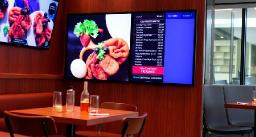
Walk into a fast-casual restaurant, a busy cafe, or a quick-service restaurant chain today, and you are likely to see bright digital screens displaying colorful graphics, menu items, and attractive food photography instead of traditional printed menus.
Digital menu boards, often called restaurant TV menus, have evolved from being a novelty to becoming an increasingly important part of modern restaurant operations.
These displays are changing how restaurants communicate with customers, manage daily activities, and strengthen their brands.
But what makes them so valuable, and should restaurant owners consider making the switch? Let's explore.
Digital menu boards are electronic displays, typically using LCD, LED, or OLED technology, that present menu items, prices, promotional offers, and food images.
Unlike traditional printed menus, these systems use specialized software that allows owners and managers to update content quickly, schedule changes, and display rotating images or videos.
A digital menu board setup can be as simple as a single screen behind an ordering counter or as advanced as a synchronized multi-screen system in a large restaurant chain.
The technology has developed considerably in recent years.
Cloud-based content management systems allow restaurant owners to change prices remotely, schedule breakfast menus to switch automatically to lunch menus at 11 a.m., or introduce limited-time offers across dozens of locations through a centralized dashboard.
This flexibility makes digital menu boards for restaurants useful for both independent establishments and multi-location businesses.
One of the most obvious advantages of digital menu boards is the ability to update content within seconds.
Restaurants can quickly change prices, remove sold-out products, introduce seasonal specials, or update allergen information.
With traditional printed menus, these changes often require new materials, manual adjustments, or temporary notices placed over existing signs.
Digital systems eliminate much of this inconvenience.
For example, if a restaurant runs out of a particular dish during the lunch rush, employees can mark it as unavailable through the content management system.
Customers then see more accurate information, reducing confusion and unnecessary explanations at the counter.
This flexibility also helps restaurants respond more efficiently to changing ingredient costs and promotional requirements.
Digital menu boards allow restaurants to present food in an attractive and engaging way through high-resolution photography, videos, and animations.
A close-up video of a burger cooking on a grill or chocolate sauce flowing over a dessert can make menu items more appealing than a plain text description.
These visuals attract attention and may encourage customers to explore products they had not originally considered ordering.
Restaurants can also use digital screens to feature signature dishes, seasonal items, and higher-margin products.
This approach creates opportunities for additional purchases through visual merchandising.
However, the content should remain balanced. Attractive food photography can support sales, but excessive animation or overcrowded layouts may distract customers from the information they need.
Digital menu boards support dayparting, which allows restaurants to change their displayed menus automatically according to the time of day.
For example, a cafe can feature pastries and coffee in the morning, sandwiches at lunchtime, and dinner specials in the evening.
These transitions can happen at scheduled times without requiring employees to replace menus manually.
Some restaurants also use digital systems to adjust prices or promotional offers according to business conditions.
For example, a restaurant may advertise discounted combinations during quieter periods or highlight premium menu items during busy hours.
Dynamic pricing and promotional strategies should be implemented transparently so customers can easily understand the prices being displayed.
When managed carefully, these features provide greater flexibility in how restaurants present their offerings throughout the day.
Modern diners often value convenience, speed, and straightforward ordering.
Digital menu boards can support these expectations by presenting menu information in a clear, organized format.
Customers can review available options while waiting in line, helping them decide what to order before reaching the counter.
Well-designed screens also make it easier to locate dietary labels, calorie information, and allergen warnings where applicable.
For restaurants serving customers from different language backgrounds, digital displays may support multilingual content or alternate between languages.
Large fonts, consistent formatting, and appropriate contrast can further improve readability.
These features can make ordering more convenient for a wider range of customers while supporting smoother service during busy periods.
Digital menu boards can work alongside point-of-sale (POS) systems to keep menu information consistent with restaurant records.
When properly integrated, the displays can reflect changes in product availability or pricing without requiring repeated manual updates.
This reduces the risk of displaying unavailable items and helps employees manage menu changes more efficiently.
Restaurant TV menus also provide opportunities for upselling.
For example, a digital board might display a message such as "Add a drink for $2" alongside a featured meal.
Combo offers, loyalty programs, desserts, and other add-ons can also be promoted through carefully positioned content.
When these suggestions are relevant and easy to understand, they may encourage additional purchases and increase average order value.
For restaurant chains and franchise operators, maintaining consistent branding can be challenging.
Digital menu boards make this process easier through centralized content management.
Corporate teams can develop approved templates, promotional campaigns, and visual guidelines, then distribute them across connected locations.
This helps maintain consistency in colors, fonts, images, and marketing messages.
At the same time, suitable software can allow regional managers to make authorized adjustments for local pricing, product availability, or location-specific promotions.
This combination of centralized control and local flexibility can improve brand consistency without limiting operational needs.
The effectiveness of a digital menu board depends heavily on its design.
Cluttered screens, small text, and distracting transitions can confuse customers and make ordering more difficult.
Several design principles can help restaurants achieve better results.
A successful digital menu board should make ordering easier while presenting products attractively.
Before installing digital menu boards for restaurants, owners should evaluate the costs and technical requirements involved.
A basic single-screen installation may be relatively affordable, while a large multi-screen deployment can require a substantial investment.
The total cost depends on the displays, mounting equipment, installation, content management software, and content creation requirements.
Restaurant owners should compare these expenses with potential savings from reduced printing and manual menu updates, along with opportunities for improved merchandising.
Reliable connectivity is another important consideration.
A stable internet connection makes remote management easier, but systems with offline playback capabilities can help prevent blank screens during temporary network interruptions.
Placement also matters.
Screens should be installed at suitable viewing heights and angles, with minimal glare and clear visibility from the ordering line.
Outdoor drive-thru displays require additional features, including weather-resistant enclosures and high-brightness screens that remain readable in sunlight.
Choosing reliable hardware and planning backup procedures can help reduce disruptions during busy service periods.
Restaurant TV menu is becoming increasingly intelligent and interactive.
Self-ordering kiosks, mobile ordering integration, and AI-assisted personalization are creating new opportunities for digital menu systems.
Some advanced platforms can adjust featured content according to the time of day, weather conditions, or product availability.
Voice-activated ordering and augmented reality food previews are also being explored as possible additions to future restaurant experiences.
As display technology becomes more accessible and content management platforms become easier to operate, digital menu boards are likely to become increasingly common among independent restaurants as well as large chains.
The challenge for restaurant owners will be selecting technologies that genuinely improve service instead of adding unnecessary complexity.
Restaurant TV menus are more than a technological upgrade. They are valuable tools for marketing, operations, and customer communication.
Digital menu boards provide flexibility that traditional printed menus cannot easily match.
When designed and managed effectively, they can support sales, reduce recurring printing expenses, improve menu accuracy, and strengthen brand identity.
In a competitive industry where visual presentation and customer convenience matter, investing in digital menu boards can help restaurants respond more effectively to changing expectations.
The important decision is not simply whether to adopt digital technology, but how to use it in a way that delivers lasting value to both the business and its customers.
| No comments yet. Be the first. |
