


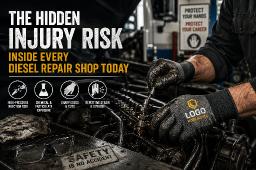
Walk into almost any diesel repair shop and the visible safety culture looks solid: safety glasses on, steel-toe boots laced up, lockout/tagout tags hanging where they should be. What most shops miss is the risk sitting in plain sight on every technician's hands. Diesel repair work exposes hands to a mix of high-pressure fluids, corrosive chemicals, sharp components, and repetitive strain that a standard automotive glove was never built to handle. That gap between what shops think they're protecting against and what actually causes hand injuries is where preventable incidents keep happening.
A light-duty auto shop and a commercial diesel bay share a floor plan, but the hazard profile underneath is not the same. Heavy-duty platforms run systems that most general mechanics never encounter, and each one carries a specific hand-safety implication.
Modern common rail diesel fuel injection systems operate at pressures that can exceed 30,000 PSI. At that pressure, a pinhole leak does not spray fuel the way a garden hose leaks water. It can inject fluid directly under the skin, an injury that looks minor on the surface and can cause serious tissue damage within hours if it goes untreated. Technicians working around fuel rails and injectors are dealing with a hazard that a typical cotton or leather work glove offers almost no meaningful protection against.
Diesel particulate filter (DPF) service generates carcinogenic particulate matter. Diesel exhaust fluid (DEF) systems introduce ammonia vapor and a corrosive fluid that degrades unprotected skin over repeated exposure. Add in solvents, brake cleaner, used oil, and coolant, and a technician's hands are in near-constant contact with substances that cause more than cuts. They cause the kind of slow-building skin damage that rarely gets logged as a workplace injury until it becomes chronic.
The numbers back up what shop floors already suggest. Bureau of Labor Statistics data shows that diesel service technicians and mechanics consistently report above-average rates of nonfatal occupational injuries and illnesses, with the upper extremities and trunk accounting for a disproportionate share of those cases. Separate BLS figures for automotive mechanics broadly found sprains, strains, and tears to be the most common injury type, with over 2,100 cases reported in a single recent year, and the hands and back identified as the most frequently affected body parts.
Mechanics as an occupation have also historically ranked among the highest for injury rates requiring days away from work, a pattern that has held steady for years rather than improving on its own. None of this shows up as a single dramatic incident. It shows up as a slow accumulation of lacerations, burns, chemical contact injuries, and repetitive strain claims that add up across a shop's payroll and insurance costs over a season.
Every shop has gloves somewhere. The problem is rarely a total absence of PPE. It's a mismatch between what's on the shelf and what the job actually demands.
Many shops standardize on a single glove for every task because it's simpler to order and easier to stock. That single glove is usually chosen for general durability, not for the specific hazard of fuel-rail work, DPF handling, or battery and high-voltage service on modern hybrid-diesel platforms. A glove that's fine for general wrench work offers little defense against high-pressure fluid injection or ammonia exposure from DEF systems, yet it keeps getting reissued because no one has mapped glove type to task.
Research into car repair workers has documented meaningfully higher rates of occupational hand dermatitis among technicians regularly exposed to oils, solvents, and cleaning agents compared to workers without that exposure. This kind of injury builds slowly. A technician doesn't report a single incident; they report cracked, irritated skin months into the job, by which point the damage is harder to reverse. It rarely shows up in a shop's incident log the way a laceration does, which is exactly why it goes unaddressed for so long.
A shop doesn't need a full PPE overhaul to close this gap. It needs a glove standard that actually matches the tasks being performed in the bay.
Instead of one glove for every job, group tasks into a small number of categories: fuel system and injector work, DPF and DEF service, general mechanical and lifting work, and electrical or high-voltage service on newer platforms. Each category has a different primary hazard, and each should have a glove spec that actually addresses it rather than a single compromise glove trying to cover all four.
A cut-resistant or chemical-resistant glove that doesn't fit gets pulled off within the first ten minutes of a task, which defeats the entire purpose of issuing it. This is where shop managers are increasingly moving away from generic one-size bulk cases toward suppliers who can match sizing and grip to the actual technician wearing them. Shops that switch from a mismatched bulk order to a task-matched program from a supplier like Logo Work Gloves typically see better day-to-day compliance simply because the gloves fit the hand and the job well enough that technicians keep them on instead of working bare-handed out of frustration.
Durability matters here too. A diesel bay is hard on gloves; a pair that shreds after a week of fuel system work gets removed and not replaced fast enough, leaving the technician exposed until the next supply order comes in. Building a program around gloves rated for the specific chemical and mechanical stress of diesel work, rather than the cheapest bulk case available, closes that gap.
Fixing this doesn't require a new safety department. A shop manager can move the needle with a short, practical process:
Shops that have gone through this process, and paired it with a properly sized, task-specific program from a supplier such as Logo Work Gloves, tend to report the change less as a compliance exercise and more as something technicians actively notice and appreciate on the floor.
Lacerations and strain-related injuries are the most frequently reported, but high-pressure fluid injection injuries from common rail fuel systems are considered the most serious because they can appear minor on the surface while causing significant internal tissue damage.
Cut resistance alone is not enough. Diesel shops also need chemical resistance for DEF, solvents, and used oil, along with task-specific durability for high-pressure fuel system work, so a single generic cut-resistant glove typically leaves gaps in protection.
Replacement should be based on visible wear and chemical exposure rather than a fixed schedule. Gloves used regularly for fuel system or DEF work degrade faster than gloves used for general mechanical tasks and should be inspected more frequently.
Yes. Poor fit is one of the main reasons technicians remove gloves mid-task, which directly increases exposure to cuts, burns, and chemical contact. Properly sized gloves matched to the task see meaningfully higher compliance on the shop floor.
The visible parts of a diesel shop's safety program, glasses, boots, lockout procedures, are rarely the problem. The overlooked risk is what happens to technicians' hands during fuel system work, DPF and DEF service, and daily exposure to oils and solvents that a single generic glove was never designed to handle. Mapping glove type to actual task, fixing sizing, and working with a supplier that treats hand protection as task-specific rather than one-size-fits-all, the kind of approach a brand like Logo Work Gloves is built around, turns hand safety from an overlooked line item into one of the highest-return investments a diesel shop can make.
| No comments yet. Be the first. |
