


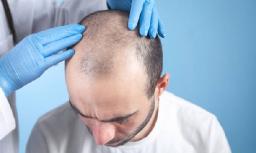
One of the first questions people ask when considering hair restoration is how many grafts they will need. The answer is not a fixed number because every patient's pattern of hair loss, donor supply, hair characteristics, and restoration goals are different. A person with a slightly receding hairline may require far fewer grafts than someone with extensive thinning across the frontal scalp, mid-scalp, and crown.
Understanding how graft requirements are determined can help you avoid choosing a treatment plan based only on a number advertised by a clinic. The right number should be based on your individual scalp assessment and the amount of coverage that can realistically be achieved while protecting your donor area.
A graft is a small unit of tissue containing one or more hair follicles. During a hair transplant, grafts are harvested from a donor area and transplanted into areas affected by hair loss.
A graft is not necessarily the same as a single hair. Depending on the follicular unit, one graft may contain one, two, three, or sometimes more individual hairs. Therefore, when comparing Hair Transplant in Riyadh plans, it is important to understand both the number of grafts and the estimated number of hairs they contain.
The quality and characteristics of the grafts can also influence the final appearance. For example, grafts containing multiple hairs can contribute to density in areas behind the hairline, while single-hair grafts may be useful for creating a softer and more natural-looking frontal edge.
The main reason graft requirements differ is that hair loss is not the same for everyone. The size of the bald or thinning area has a direct impact on how many grafts may be needed.
Someone with mild temple recession may need a relatively small number of grafts. A person with a significantly receding hairline may require more. Extensive baldness involving the frontal scalp, mid-scalp, and crown can require a considerably larger number.
The desired density also matters. Patients seeking subtle coverage may require fewer grafts than those wanting a denser appearance. However, using more grafts does not automatically produce a better result because the donor area has limitations.
A receding hairline often requires fewer grafts than extensive scalp restoration because the affected area is relatively localized. However, the exact requirement depends on how far the hairline has moved backward and how wide the area of recession is.
The surgeon also needs to consider the desired position of the new hairline. Lowering the hairline significantly requires more grafts than making a conservative correction.
A natural-looking hairline should also have appropriate density and irregularity rather than appearing like a solid line of transplanted hair. Careful graft distribution can therefore be more important than simply increasing the total number of grafts.
The crown can be more challenging to restore because it is often a larger circular or expanding area. Hair grows in a distinctive whorl pattern in this region, so grafts must be positioned according to the natural direction of growth.
The number of grafts required depends on the size of the thinning area and the amount of existing hair that remains. A crown with some existing density may require fewer grafts than a completely bald crown.
In some cases, the surgeon may prioritize the frontal scalp before the crown, especially when donor hair is limited. This allows the available grafts to be used in areas that have the greatest impact on overall appearance.
Yes. Natural hair density varies between individuals. Someone with naturally thick hair may require a different number of grafts to achieve a visually full result than someone with finer hair.
Hair shaft thickness is also important. Thicker hair can provide greater visual coverage, while fine hair may require more strategic placement to create the appearance of density.
The surgeon should therefore evaluate your existing hair characteristics rather than calculating graft requirements based solely on the size of the bald area.
The donor area determines how many follicles are realistically available for transplantation. Hair is commonly harvested from the back and sides of the scalp because follicles in these regions are generally more resistant to the pattern of hair loss.
However, donor hair is a limited resource. Removing too many grafts can cause visible thinning in the donor area and reduce the follicles available for future procedures.
A good treatment plan therefore aims to achieve the best possible coverage while preserving donor hair for the future. This is particularly important for younger patients or people whose hair loss may continue to progress.
No. More grafts do not automatically mean a better hair transplant. The placement, angle, direction, distribution, and quality of the grafts all influence the final result.
If grafts are placed too densely or harvested too aggressively, the procedure may create unnecessary risks. The surgeon must also consider whether the recipient area can accommodate the planned grafts appropriately.
The objective should be to use the available donor hair efficiently. A smaller number of well-placed grafts can sometimes create a more natural appearance than a larger number placed without careful planning.
The required graft count is mainly determined by the area being restored and the desired density rather than simply by the technique. FUE and DHI are commonly used approaches, but the appropriate technique depends on the patient's individual circumstances and the surgeon's assessment.
FUE involves extracting individual follicular units from the donor area before placing them into recipient sites. DHI uses a specialized implantation approach for placing harvested follicles.
Regardless of the technique, the surgeon still needs to determine how many grafts are required and how many can safely be harvested from the donor area.
They can. Hair loss may continue after a transplant, particularly in untreated natural hair. This means that a patient who initially requires a certain number of grafts may potentially need additional treatment in the future if further hair loss occurs.
For this reason, the surgeon should consider your long-term hair-loss pattern when designing the initial treatment. Using all available donor grafts immediately may leave insufficient resources for future needs.
A conservative and sustainable plan can help preserve the donor area while addressing the most important areas first.
During a consultation, the specialist may examine your scalp, donor density, hair thickness, hair-loss pattern, and the areas you want to restore. The clinician can then estimate how many grafts may be required.
The assessment should also consider your future hair-loss risk. A hairline that looks appropriate today may need to remain suitable if surrounding natural hair becomes thinner later.
Your goals should be discussed as well. Someone primarily concerned with temple recession may have a different treatment plan from someone seeking coverage across the entire top of the scalp.
Some patients can achieve their desired coverage in one session, particularly when the affected area is relatively small. Others may need multiple sessions because of extensive hair loss or the amount of donor hair that can safely be harvested at one time.
A large procedure is not necessarily better than a staged approach. In some cases, dividing treatment into separate sessions allows the surgeon to preserve donor hair and assess the results before planning additional restoration.
The number of sessions should therefore be determined alongside the graft requirement.
If you are considering Hair Transplant in Riyadh, the most reliable way to determine your graft requirement is through a personalized assessment by a qualified hair transplant specialist. Online calculators and generic graft numbers can provide only broad estimates because they cannot fully account for your donor density, hair thickness, facial proportions, or future hair loss.
During your consultation, ask the specialist to explain why a particular number of grafts is being recommended. You should also understand which areas will be treated first, how the donor area will be protected, and whether additional sessions may be necessary in the future.
There is no universal number of grafts that every hair transplant patient needs. The requirement depends on the size and pattern of hair loss, desired density, hair characteristics, donor supply, and long-term restoration goals.
A receding hairline may require a relatively modest number of grafts, while extensive thinning across multiple scalp areas can require substantially more. However, using the highest possible number of grafts is not necessarily the best approach.
The goal should be to achieve natural-looking coverage while preserving enough donor hair for future needs. A detailed scalp and donor-area assessment is therefore essential before deciding how many grafts should be transplanted.
| No comments yet. Be the first. |
