

Imagine a family dinner that suddenly goes quiet. Someone stares blankly for a minute, doesn’t respond, and then carries on as if nothing happened. Most of us would brush it off as tiredness. But sometimes, that is a seizure.
Seizures are far more common than people think, and they don’t always look like the dramatic shaking we see in films. That is why many people in the city go years without a proper diagnosis. If you have been searching for an epilepsy specialist in Delhi, this guide will help you understand when to see one and what to expect.
Any doctor can give first aid during a seizure. But epilepsy care goes much deeper than that. Choosing the right medicine depends on the exact type of seizure, the person’s age, other health conditions, and even their daily routine.
An epileptologist is a neurologist who has trained further in epilepsy and brain-wave (EEG) interpretation. This matters because a wrong diagnosis is surprisingly common. Fainting, panic attacks and certain sleep problems can look like seizures, and the reverse is true too. Getting it right the first time saves months of trial and error.
Don’t wait for a “big” seizure. Consider seeing a specialist if:
Not sure whether your symptoms count? The Symptoms & When to Consult page is a helpful starting point.
A quick safety note: if a seizure lasts more than five minutes, repeats without recovery, or the person is injured or struggling to breathe, go to the nearest hospital straight away.
Many people feel nervous before their first consultation, so here is the usual flow. The doctor will spend most of the time listening. What happened before the episode? What did it look like? How long did it last? How did the person feel afterwards?
If someone saw the seizure, bring them along. A short phone video of an episode can also help enormously, because doctors can often recognise the seizure type from it.
Depending on your story, your neurologist may suggest:
None of these tests is meant to scare you. Each one simply gives your doctor a clearer picture so the treatment can be matched to you.
Epilepsy is highly treatable. With the right medicine, taken regularly, a large majority of people get their seizures under control and live normal, active lives. Good sleep, regular meals, less stress and avoiding alcohol all help too.
For some people, though, seizures continue despite two or more well-chosen medicines. This is called drug-resistant epilepsy, and it is not the end of the road. It is the point at which a deeper evaluation becomes important, including a pre-surgical evaluation to see whether surgery could help.
When you compare options for seizure treatment in Delhi, look at a few practical things:
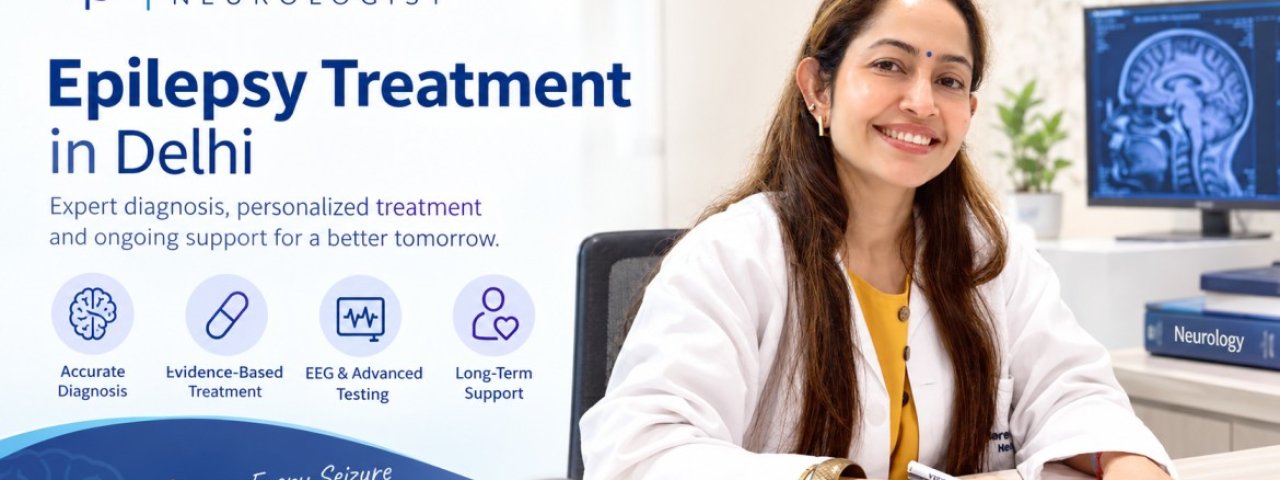
Dr. Seema Shahi is a USA-trained neurologist and epileptologist with over 15 years of experience in epilepsy and advanced EEG. She holds an MD (Internal Medicine) and DNB (Neurology), and completed a fellowship in EEG and epilepsy in the USA. She has worked at Medanta – The Medicity, Artemis Hospital and the University of Louisville.
Dr. Shahi consults at Pacific OneHealth in Karol Bagh, Dwarka and Lajpat Nagar, and her approach to epilepsy diagnosis and management is built around one idea: every patient’s seizures are different, so every treatment plan should be too. If travelling is difficult, an online consultation is also available.
Living with uncertainty is exhausting, for the person with seizures and for the family around them. The sooner you meet an epilepsy specialist in Delhi, the sooner you get answers, and for most people, control.
Ready to take the first step? Request an appointment or call +91 99530 19290.
Disclaimer: This article is for general awareness only and does not replace medical advice. Please consult a qualified neurologist for diagnosis and treatment.
| No comments yet. Be the first. |
