


Two people can clean the same driveway with the same pressure washer and get results that look nothing alike. One driveway comes up an even, consistent color from edge to edge. The other comes up streaked, with light and dark bands running across the concrete. The difference usually is not the machine or the person. It comes down to which attachment they put on the end of the hose.
The choice between a surface cleaner and a wand concrete is one of the biggest factors in how flat concrete turns out, and it is worth knowing the difference before you clean a driveway yourself or hire someone to do it. Here is how the two tools work and why one leaves a better finish on large areas.
What a Wand Actually Does
The wand is the tool most people picture when they think of a pressure washer.
A Narrow, Concentrated Stream
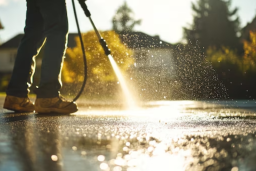
A wand puts out a single stream of water through one nozzle. That stream is narrow and concentrated, which makes it good at focused work. You aim it, it cleans a thin path, and you move on to the next path. All the pressure the machine produces goes into that one small point of contact.
Great for Detail, Hard on Consistency
The wand shines on detail work. Cleaning the corners of steps, blasting a stubborn oil spot, cutting through grime in a tight space, and reaching odd angles are all jobs a wand handles well. The trouble starts when you try to clean a large flat area with it. Covering a whole driveway means waving the wand back and forth across hundreds of overlapping passes, and keeping every one of those passes even is close to impossible.
Why Wands Cause Striping
Since the wand cleans a narrow path, any change in how you move it shows up on the concrete. Move a little faster on one pass and that strip gets less cleaning. Hold the wand closer on another pass and that strip gets more. The result is the striped, uneven look that people find after a driveway cleaning, with bands of clean and less-clean concrete sitting next to each other.
What a Surface Cleaner Does Differently
A surface cleaner is built for exactly the job a wand struggles with.
Spinning Bars Under a Housing
A surface cleaner looks like a round housing that sits flat on the ground. Underneath it, two or more nozzles are mounted on a bar that spins fast, spraying water in a circular pattern. The housing keeps that spray contained and holds the nozzles at a fixed height and distance from the surface. You push it along like a floor buffer, and it cleans a wide path in one pass.
Even Coverage Across Its Whole Width
The reason a surface cleaner leaves an even finish is that it takes the human inconsistency out of the process. The nozzles are always the same distance from the concrete, always moving at the same speed relative to the housing, and always covering the full width evenly. There are no bands, because every part of the path gets the same treatment. You just keep the passes overlapping and the whole slab comes up uniform.
Faster & Cleaner on Big Areas
Beyond the even finish, a surface cleaner covers ground far faster than a wand on a large area. It also keeps the water and debris contained under the housing instead of spraying it across the yard, so there is less overspray on the siding, the cars, and the plants nearby.
When Each Tool Is the Right Call
Neither tool is better in every situation. They do different jobs.
Use the Surface Cleaner for Flat Expanses
Driveways, patios, pool decks, sidewalks, and any large flat concrete or paver area are surface cleaner territory. Anywhere you need an even color across a broad space, that is the tool that gets you there.
Use the Wand for Everything Else
Edges, corners, steps, vertical surfaces, tight spots, and focused stain removal all call for the wand. The wand also handles the trim work around the surface cleaner's path, since the round housing cannot get all the way into a corner. In practice, a good driveway cleaning uses both. The surface cleaner does the main field, and the wand finishes the edges and details.
Why the Right Tool Matters for the Result
The equipment choice is not just about speed. It decides how the finished job looks.
An Even Finish Comes From Even Cleaning
The uniform look everyone wants on a clean driveway comes from cleaning every part of it the same amount. A surface cleaner does that by design. Trying to reach the same result with a wand alone means fighting the tool the entire time, and small inconsistencies still slip through.
Pre-Treatment Helps Either Tool
Applying a cleaning solution and letting it work before running the surface cleaner makes the whole job more even, because the grime is already broken down before the pressure touches it. This matters even more when a wand is involved, since it takes pressure off the tool to do all the work.
The Wrong Tool Shows Up Later
Stripes and uneven patches often do not appear until the concrete dries, which is why people sometimes think a job went fine and then find problems the next day. Using the right tool from the start avoids the callback and the redo.
What This Means When You Hire Someone
If you are hiring out a driveway or patio cleaning, the equipment the crew brings tells you a lot about the result you will get. A crew planning to clean a big slab with a wand alone is a crew likely to leave stripes. A crew using a surface cleaner for the field and a wand for the details is set up to leave an even finish.
Jacobson's Power Washing cleans concrete across Richmond, Midlothian, Glen Allen, and the surrounding areas using surface cleaners on the flat expanses and wands for the edges and detail work, which is the pairing that keeps driveways and patios an even color from one side to the other. For a homeowner comparing options, asking how a crew plans to handle the flat areas is a fair question, and the answer says a lot.
The tools are not exotic and neither is the idea behind them. Even cleaning gives an even finish, and the surface cleaner is what makes even cleaning possible on a large area. Matching the tool to the surface is most of the job.
| No comments yet. Be the first. |
