
Blogs
Top Tips for Choosing the Right Partners to Build Your App and Your Business Website
By quantumitinnovation, 2026-11-04

Looking for a React Native developer Melbourne businesses trust, or a website development company Brisbane owners rely on? Read practical tips for choosing the right partners.
Building a mobile app or a business website is a big step, and the people you choose will shape how the project turns out. Many owners spend weeks comparing quotes but forget to ask about experience, communication, and what happens after launch. Some hire quickly after one polished meeting, then find the result does not match how their business actually works. If you are searching for a React Native developer Melbourne projects can depend on, it helps to know what good work looks like before you commit any budget. This guide shares practical lessons from projects that went smoothly and a few that did not, so you can make a calmer and better informed decision.
Why the Right Development Partner Matters
A digital project is rarely a one time purchase. Your app or website will need updates, fixes, and new features as your business grows and your customers change. A weak partner can leave you with slow screens, buggy features, and code that nobody else can understand. A strong partner builds something clean, documented, and easy to improve later. That difference often decides whether your project becomes a useful business tool or an expensive headache.
Start With Clear Goals
The best projects begin with a simple question: what should this app or website do for your business? Maybe you want more bookings, more online orders, or an easier way for customers to reach you. A good partner asks about these goals before talking about features or design. If someone starts pitching ideas in the first few minutes without understanding your customers, take that as a warning sign. Clear goals make it much easier to judge whether the finished product is working.
What Real Experience Looks Like
Experience shows up in the details. A skilled developer can explain why they chose a certain approach in plain language instead of hiding behind technical terms. They share examples of past work, talk openly about problems they solved, and admit when something turned out harder than expected. Ask to try live apps or websites they have built, and open them on your own phone. Loading speed, smooth navigation, and clear layouts tell you far more than any sales pitch.
Questions Worth Asking Before You Hire
Good questions save you from bad surprises. Ask how many similar projects the team has finished and how they handle changes halfway through a build. Find out who you will speak with each week and how often you will receive progress updates. Ask what happens after launch, including bug fixes, updates, and support. Clear and relaxed answers usually point to a team that is organised and honest about what it can deliver.
Why React Native Suits Many Apps
React Native lets one team build a single app that runs on both iPhone and Android, which can cut development time and cost compared with building two separate apps. It suits booking tools, service apps, customer portals, and many startup ideas especially well. That said, it is not perfect for every project. Apps that need heavy graphics or very specific device features may need extra native work. A trustworthy developer will tell you this upfront instead of promising that one tool solves everything.
Finding a Reliable Partner for Your Website
Your website is often the first place customers check before they call or visit. When you start looking for a website development company Brisbane owners recommend, focus on how well the team understands your customers, not only on how good the design samples look. A good company asks about your goals, your audience, and the action you want visitors to take. Then they build pages that load quickly, read clearly, and work smoothly on small screens, with a structure that search engines can understand.
Also, Read
- How Can Generative AI Consulting Drive Innovation in Your Business?
- Mobile App Development Company Singapore – Quantum IT Innovation
Signs of a Trustworthy Team
Trust builds through small habits. A reliable team gives written scopes, sets realistic timelines, and explains costs in plain language. They do not hide extra charges until the final invoice, and they hand over your files, logins, and accounts so you are never locked out of your own project. Positive reviews from real clients and a willingness to provide references are healthy signs. Be careful with anyone who rushes you to decide or promises results that sound too good to be true.
Planning Your Budget and Timeline
Cheap quotes often become expensive once fixes and rebuilds pile up. Instead of chasing the lowest price, compare what each quote actually includes. Check whether design, testing, security, store submission, and training are covered. A simple business website can take a few weeks, while an app with custom features may need a few months. Build some flexibility into your schedule, because good work needs time for feedback and testing. Starting with a smaller first version and adding features later is a smart way to control risk.
Final Thoughts
Choosing development partners is about more than technical skill. You want people who listen, explain things clearly, and treat your project as seriously as you do. Take your time, ask questions, test their past work, and trust your instincts if something feels unclear. A careful decision today can save you months of frustration and give your business an app and a website that customers genuinely enjoy using.
To explore how Quantum IT Innovation can help grow your business, feel free to get in touch with their team today and talk to our experts for tailored solutions.

Imagine a family dinner that suddenly goes quiet. Someone stares blankly for a minute, doesn’t respond, and then carries on as if nothing happened. Most of us would brush it off as tiredness. But sometimes, that is a seizure.
Seizures are far more common than people think, and they don’t always look like the dramatic shaking we see in films. That is why many people in the city go years without a proper diagnosis. If you have been searching for an epilepsy specialist in Delhi, this guide will help you understand when to see one and what to expect.
Why an Epilepsy Specialist and Not Just Any Doctor?
Any doctor can give first aid during a seizure. But epilepsy care goes much deeper than that. Choosing the right medicine depends on the exact type of seizure, the person’s age, other health conditions, and even their daily routine.
An epileptologist is a neurologist who has trained further in epilepsy and brain-wave (EEG) interpretation. This matters because a wrong diagnosis is surprisingly common. Fainting, panic attacks and certain sleep problems can look like seizures, and the reverse is true too. Getting it right the first time saves months of trial and error.
Signs That It’s Time to Book an Appointment
Don’t wait for a “big” seizure. Consider seeing a specialist if:
- You or a loved one has had a seizure for the first time, even if they seemed fine afterwards.
- There are repeated episodes of blanking out, staring, or sudden confusion.
- Seizures continue even though you are taking medicines.
- Medicines are causing drowsiness, mood changes or memory trouble.
- A seizure has followed a head injury, stroke or brain infection.
- A child has repeated convulsions or seems to “switch off” often.
- You are planning a pregnancy and are on anti-seizure medicines.
Not sure whether your symptoms count? The Symptoms & When to Consult page is a helpful starting point.
A quick safety note: if a seizure lasts more than five minutes, repeats without recovery, or the person is injured or struggling to breathe, go to the nearest hospital straight away.
What Happens at the First Visit?
Many people feel nervous before their first consultation, so here is the usual flow. The doctor will spend most of the time listening. What happened before the episode? What did it look like? How long did it last? How did the person feel afterwards?
If someone saw the seizure, bring them along. A short phone video of an episode can also help enormously, because doctors can often recognise the seizure type from it.
Tests You May Be Asked to Do
Depending on your story, your neurologist may suggest:
- An EEG: a painless test that records the brain’s electrical activity.
- Video EEG monitoring: brain waves and video are recorded together, which helps tell epileptic seizures from look-alike episodes and shows where seizures begin.
- MRI of the brain: to check for scars, developmental changes or other structural causes.
- Blood tests: to rule out sugar, salt or infection-related triggers.
None of these tests is meant to scare you. Each one simply gives your doctor a clearer picture so the treatment can be matched to you.
Treatment: The Good News
Epilepsy is highly treatable. With the right medicine, taken regularly, a large majority of people get their seizures under control and live normal, active lives. Good sleep, regular meals, less stress and avoiding alcohol all help too.
For some people, though, seizures continue despite two or more well-chosen medicines. This is called drug-resistant epilepsy, and it is not the end of the road. It is the point at which a deeper evaluation becomes important, including a pre-surgical evaluation to see whether surgery could help.
How to Choose the Right Doctor
When you compare options for seizure treatment in Delhi, look at a few practical things:
- Training in epilepsy and EEG, not only general neurology.
- Access to proper testing, including video EEG, so you don’t have to move between centres.
- Clear communication. You should leave the clinic understanding your diagnosis and plan.
- Follow-up support, since epilepsy care is a long-term partnership.
- Convenience. A clinic close to home makes regular follow-ups much easier to keep.
Meet Dr. Seema Shahi
Dr. Seema Shahi is a USA-trained neurologist and epileptologist with over 15 years of experience in epilepsy and advanced EEG. She holds an MD (Internal Medicine) and DNB (Neurology), and completed a fellowship in EEG and epilepsy in the USA. She has worked at Medanta – The Medicity, Artemis Hospital and the University of Louisville.
Dr. Shahi consults at Pacific OneHealth in Karol Bagh, Dwarka and Lajpat Nagar, and her approach to epilepsy diagnosis and management is built around one idea: every patient’s seizures are different, so every treatment plan should be too. If travelling is difficult, an online consultation is also available.
Don’t Wait for the Next Seizure
Living with uncertainty is exhausting, for the person with seizures and for the family around them. The sooner you meet an epilepsy specialist in Delhi, the sooner you get answers, and for most people, control.
Ready to take the first step? Request an appointment or call +91 99530 19290.
Disclaimer: This article is for general awareness only and does not replace medical advice. Please consult a qualified neurologist for diagnosis and treatment.
Boundary Scan Hardware Market to Reach US$ 1,512.75 Million by 2034, at a CAGR of 8.5%
By sammkaran, 2026-11-04
Boundary Scan Hardware utilizes a single-bit Bypass Register to optimize test times for long JTAG chains. When a device is placed in bypass mode, data flows directly from TDI to TDO through this minimal register. This prevents unnecessary propagation delays through chips that do not need to be tested during a specific cycle. By shortening the active scan path, overall manufacturing test throughput is significantly enhanced.
The global Boundary Scan Hardware Market was valued at US$ 728.57 million in 2025 and is projected to reach US$ 1,512.75 million by 2034, expanding at a Compound Annual Growth Rate (CAGR) of 8.5% during the forecast period from 2026 to 2034.
The rapid advancement of miniaturized electronics, multi-layer printed circuit boards (PCBs), and the surging adoption of Internet of Things (IoT) devices across automotive, telecommunications, and industrial sectors serve as primary drivers for the sustained growth of boundary scan hardware solutions.
Key Drivers & Market Growth Dynamics
Boundary scan testing (IEEE 1149.1 standard and its extensions) has become an essential methodology for structural and functional testing of complex integrated circuits and densely populated circuit assemblies. As physical pin access becomes increasingly restricted on modern micro-architectures, traditional bed-of-nails or in-circuit testing (ICT) techniques face operational limitations. Boundary scan hardware addresses these physical access constraints by enabling non-intrusive electrical testing and on-board programming directly through a standardized Joint Test Action Group (JTAG) boundary-scan architecture.
Major market highlights include:
-
Rising Complexity in PCB Design: Shrinking component sizes and high-density interconnect (HDI) technologies demand reliable non-contact testing solutions to maintain quality control without damaging sensitive silicon traces.
-
Automotive Electronics Surge: The expansion of Electronic Control Units (ECUs) in Advanced Driver Assistance Systems (ADAS), electric vehicles (EVs), and connected mobility has heightened demand for high-reliability JTAG testing equipment.
-
Integration with Automated Manufacturing: Manufacturers are integrating boundary scan hardware directly into inline automated test equipment (ATE) setups to streamline production lines and optimize time-to-market performance.
Get a PDF Sample- https://www.theinsightpartners.com/sample/TIPRE00011807
Key Industry Players
The competitive landscape of the Boundary Scan Hardware Market features established global testing and measurement solution providers alongside specialized hardware and software innovators. Prominent industry players shaping the market include:
-
Keysight Technologies Inc
-
Teradyne Inc
-
Konrad GmbH
-
Acculogic Inc
-
Corelis Inc.
-
GÖPEL electronic GmbH
-
JTAG Technologies
-
XJTAG Limited
-
Qmax Test Technologies
These market leaders actively invest in continuous product innovations, strategic collaborations, and high-performance software-hardware integrations to enhance fault coverage across complex embedded system designs.
Future Outlook (2026–2034)
Looking ahead, the market is set to benefit from the convergence of artificial intelligence (AI), high-speed communication interfaces (such as 5G/6G hardware), and system-in-package (SiP) architectures.
The integration of automated fault diagnostics with boundary scan controllers is expected to significantly minimize testing cycle times and overall capital expenditure (CapEx) for high-volume electronics manufacturing facilities. Furthermore, expanding demand from aerospace, defense, and medical electronics sectors for mission-critical hardware validation will maintain strong upward market momentum throughout the 2026–2034 forecast period.
About The Insight Partners
The Insight Partners is a leading market research and consulting firm delivering actionable insights through in-depth industry analysis and strategic intelligence. The firm supports clients across various industries in making informed business decisions by providing comprehensive market forecasts, competitive assessments, and growth opportunities.
Contact Us:
If you have any queries about this report or if you would like further information, please contact us:
Contact Person: Ankit Mathur
E-mail: sales@theinsightpartners.com
Phone: +1-646-491-9876
Also Available in : Korean| German| Japanese| French| Chinese| Italian| Spanish
Rubber, Clear, or Wood-Mounted? Simple Shopify Stamp Pages That Help Artists Print the Right Way in One Tap
By roshnisingh, 2026-11-04

On a bronze-town morning in Swamimalai, an artist wanted a rubber stamp, and she did not know which stamp to choose. A photo shows the shop, and a best digital marketing agency in delhi will often say the shop is not the print, because the artist cannot see the mark. A stamp page would have shown her the stamp type first, with only rubber stamps, and she would have printed the right way.
Key Takeaways
- Make one stamp page per stamp type, with the type name, a photo, and only stamps of that type below it.
- Show the stamps, before the artist reads anything else.
- Add one stamp to start with, with a note.
Why a Mixed Shelf Does Not Print the Right Way
An artist who prints the right way thinks in stamp types, and a mixed shelf thinks in stock, so the two do not match, because she must turn a stamp type in her head into a hunt through every stamp in the shop. A photo shows the shelf, and a shopify development services agency in delhi will often say the shelf is not the print, because the artist cannot see the mark in a row of stamps. She must hunt for the stamp, and the hunt takes longer than the choosing. The stamp is only the mark, and the artist knows it the moment the page stays plain without her stamp. A stamp page fixes that, by showing one stamp type at a time, so the artist prints the right way. The shelf sells stamps, and the stamp page sells a mark, and mark-first shopping starts with her type. An artist who prints the right way will come back for the next stamp type.
Mark First, Stamps After
MarketingBugs often hears art shops say the same thing, that a stamp page sells ten stamps and a mixed shelf sells one.
What a Stamp Page Means on a Shopify Store
A stamp page is one page for one stamp type, with the type name, a photo below it, and only stamps of that type. The page shows the stamps, and a note that says start here. The type name is the word, and the stamp list is the second, because an artist who sees the list will know if the stamp fits her work. A photo shows the stamp, and a shopify development services agency in delhi will often say the stamp is the work, because the artist cannot see the mark in a photo. The list stays plain, and the artist reads it, not after. The start-here note sits beside the list, because an artist who sees one note will start at once. The stamp travels home,
One Type, One List, One Note
One stamp type per page, one stamp list below it, and one start-here note beside the list, so the artist never wonders what else the type holds.
A Swamimalai Story About a Stamp, a Note, and a Mark Printed the Right Way
Kavya sells art supplies in Swamimalai, and artists from Kumbakonam and Thanjavur shop her store on their phones. An artist from Kumbakonam wanted a rubber stamp for her card, but the rubber stamps sat between clear and wood-mounted stamps. She opened the Rubber page, saw the rubber stamps, and read the start-here note before she bought. She printed her card with her stamp, and filled her table, and a best digital marketing agency in delhi will often praise a page that prints the right way in minutes, because an artist trusts a list that forgets nothing. That one stamp page has printed her cards since, because she shops the type, not the shelf.
How to Set Up Stamp Pages in Plain Steps
Make one stamp page per stamp type, such as Rubber, Clear, and Wood-Mounted, with the type name. Add the stamps, so the artist prints the right way. A best digital marketing agency in delhi will often link the stamp pages at the top of the store, so an artist sees them at once, Keep each stamp page to one type only, because a page with every type is the whole store again. Save the type with the order, so the store sees which type sold.
Keep the Mark
The type comes first, and the stamps come after, so the artist sees her type before she shops it.
Mistakes That Make a Stamp Page Feel Like a Catalogue
The first mistake is a stamp page with every type on it, so the artist must scroll through the year to find Rubber. Another mistake is a page that never changes when new stamps arrive, so last year's list sits there in June. A shopify development services agency in delhi will often call it a list without a mark, because the artist cannot print what she reads. Do not mix types to save time, and do not list a stamp the store does not sell.
MarketingBugs often finds that one clear stamp page, kept fresh, does more than a page full of types.
Expert Tips in Plain Words
Put the stamp links in the store, so an artist sees them. Use type names, so the artist sees it.
A Weekly Check That Keeps the Stamp Pages Fresh
Count the artists who opened each stamp page, the ones who read the start-here note, and the ones who bought a stamp. Look at the quietest stamp page first, because it shows the type artists skip, and a skipped type may need a clearer photo. That weekly look is short, and a best digital marketing agency in delhi will often start with the quietest type, because one stale stamp page can stay unchanged. Keep the stamp pages to one type each, and change a page only when the count shows a clear reason.
FAQs
What is a stamp page?
It is one page for one stamp type, with the type name and a start-here note.
Does the artist have to buy the first stamp?
No. She can pick any stamp on the list.
How many stamp pages should the store show?
Start with three types: Rubber, Clear, and Wood-Mounted.
Should each stamp page show many types?
No. Show a type per page, so the stamps and the note stay clear and easy to use.
How do I choose a Shopify agency in Delhi?
Ask for a live demo on a phone, with the stamp pages clear.
Conclusion: Pick a Type, Read the Note, and Let the Artist Print the Right Way in One Tap
A stamp page works best when the artist opens one type page, reads the start-here note, and prints the right way. That page turns a hunt from a chore into a find, and a find is easier to enjoy. An artist who prints the right way will come back, and tell a friend about the page. The friend will read the note too, and a stamp page sells faster than a mixed shelf. A shopify development services agency in delhi will often say a stamp page sells faster than a mixed shelf, because an artist trusts a list that forgets nothing. She will print again, because a mark that fits is worth a second stamp.
Help from MarketingBugs can set up stamp pages for one art shop first, with three types, three lists, and a link in the store.
Officestar: Making your Further Advantageous not to mention More comfortable Work environment
By toyay75289, 2026-11-04
A well-organized office plays a significant role in maintaining productivity, improving employee comfort, and supporting everyday business activities. Officestar represents the growing interest in professional office environments, workplace solutions, and products designed to create daily tasks easier. Whether establishing a fresh office or improving a current workspace, choosing suitable equipment and furniture may make a meaningful difference.
The Importance of a Well-Designed Office
A fruitful workspace is more than just a location to accomplish daily responsibilities. It will provide comfort, organization, and an environment that encourages concentration. Proper furniture, suitable lighting, and an organized layout might help employees perform their tasks more efficiently.
A thoughtfully arranged office also creates a positive impression on clients and visitors. A clear and professional environment reflects awareness of detail and supports a company's overall image.
Choosing the Right Office Furniture
Office furniture includes a direct affect workplace comfort. Comfortable chairs, practical desks, storage cabinets, and meeting tables help create a functional environment.
Ergonomic furniture is very valuable since it supports better sitting positions during long working hours. Businesses should consider durability, material quality, design, and available space when selecting office furniture.
Improving Workplace Organization
An organized office helps reduce unnecessary distractions and makes everyday activities easier. Proper document storage, labeled folders, and accessible office supplies can save time and improve workflow.
Digital tools also can support workplace organization by helping teams manage schedules, communicate effectively, and keep track of important projects.
Modern Office Solutions
Modern workplaces increasingly give attention to flexibility and efficiency. Businesses are exploring practical office solutions that combine attractive designs with useful features.
Technology-friendly furniture, collaborative meeting spaces, and comfortable workstations can support different working styles. These improvements might help create an environment that meets the changing needs of employees.
Final Thoughts
Officestar reflects the significance of creating professional, comfortable, and organized workspaces. From selecting suitable furniture to improving office layouts, 오피스타 thoughtful workplace planning can support productivity and employee satisfaction. Investing in practical office solutions helps businesses build an environment that is both welcoming and efficient.
Zenuva is a product that can be explored by consumers who want to understand its features, ingredients, formulation, and intended purpose before making a purchase. Learning about Zenuva starts with reviewing the information provided by the manufacturer and understanding the product's specific characteristics. Customers generally look for details about ingredients, recommended usage, packaging, availability, pricing, and purchasing options when researching a new product. Having access to clear product information makes it easier to evaluate different options and establish realistic expectations. Zenuva product research should begin with examining its official description and checking the complete ingredient list. Understanding the formulation can help consumers identify individual components and determine whether any ingredients require special attention. Reading the recommended directions is equally important because proper usage and storage instructions contribute to responsible product handling. Consumers should also review relevant warnings, precautions, and safety information before considering regular use. Another important aspect of researching Zenuva is understanding its intended application. Product descriptions should provide accurate information about its purpose without making exaggerated promises or suggesting guaranteed results. Individual experiences may vary depending on personal circumstances, preferences, and other relevant factors. Customers interested in purchasing Zenuva can compare its listed price, packaging, product specifications, and availability with other alternatives. Checking the official website may also provide information about ordering procedures, payment options, shipping details, and customer support. Product authenticity is another consideration when purchasing online, so consumers should pay attention to the website and seller information. Those with allergies, existing medical conditions, or ongoing medication use should seek appropriate professional advice before trying a wellness-related product. It is also sensible to understand the applicable return policy and contact the manufacturer when important product details are unclear. Making an informed decision involves considering both the advantages and limitations of an item rather than relying exclusively on promotional content. Zenuva consumers can benefit from carefully examining available information and deciding whether the product meets their expectations. Transparent product details, clear instructions, and responsible purchasing practices contribute to a better shopping experience. Ultimately, understanding Zenuva requires thoughtful research, realistic expectations, and attention to the information supplied by the manufacturer. https://zenuva.org/
Rugged Server Market to Reach US$ 1,376.46 Million by 2034, at a CAGR of 7.5%
By sammkaran, 2026-11-04
Rugged Server network interfaces feature heavy-duty locking connectors, such as M12 or circular military-spec ports, to prevent accidental cable disconnections. These hardened Ethernet and fiber optic connections ensure continuous data transmission even during severe physical movement or mechanical strain. They maintain stable, high-bandwidth communications links between edge units and remote command networks.
The global Rugged Server Market is experiencing accelerated expansion, driven by the rapid adoption of edge computing, ongoing defense modernization initiatives, and the digitization of critical infrastructure. Engineered to deliver high-performance computing under extreme environmental conditions, rugged servers are becoming the backbone of data-intensive operations across military, industrial, aerospace, and energy sectors.
According to comprehensive industry research, the Rugged Server Market size is expected to reach US$ 1376.46 million by 2034 from US$ 716.11 million in 2025. The market is anticipated to register a Compound Annual Growth Rate (CAGR) of 7.5% from 2026 to 2034, reflecting sustained demand for resilient hardware architectures in mission-critical applications.
Accelerating Demand for High-Performance Computing at the Edge
Modern enterprise and military architectures are rapidly shifting away from centralized data centers to process intelligence directly where data is generated. Rugged servers are designed with specialized enclosures, advanced thermal management systems, and shock-and-vibration resistance to withstand extreme temperatures, dust, moisture, and electromagnetic interference.
Key growth factors propelling market momentum include:
-
Edge Computing and Artificial Intelligence Integration: The deployment of AI inference, computer vision, and real-time analytics at the operational edge requires local computing hardware capable of surviving harsh outdoor environments.
-
Defense Modernization Programs: Global armed forces are upgrading communications, tactical command-and-control, and autonomous reconnaissance systems with ruggedized rack-mount and portable servers.
-
Industrial Automation & Industry 4.0: Energy utilities, mining operations, oil and gas exploration, and intelligent transportation networks rely heavily on rugged servers to prevent downtime and manage high-volume IoT telemetry.
Get a PDF Sample- https://www.theinsightpartners.com/sample/TIPRE00011143
Competitive Landscape & Key Players
The global rugged server market is marked by strategic innovations, technological partnerships, and hardware optimization for low-latency processing. Leading players are investing heavily in modular chassis designs, zero-trust hardware security, high-speed 5G connectivity integration, and energy-efficient processing nodes.
Key industry participants shaping the competitive landscape include:
-
Core Systems
-
CP North America
-
Crystal Group Inc.
-
Dell Inc.
-
Mercury Systems Inc.
-
Systel Inc.
-
Trenton Systems Inc.
-
Kontron AG
-
Advantech Co. Ltd.
-
Hiper Global
-
Rugged Science
-
H3 Platform Inc.
Market leaders continue to enhance product portfolios with high-capacity storage configurations, GPU acceleration for tactical AI workloads, and compliance with stringent environmental and military standards such as MIL-STD-810H and MIL-STD-461.
Future Outlook (2026–2034)
Looking ahead, the rugged server landscape will be defined by several key technological transitions:
-
AI-Enabled Edge Intelligence: Advanced rugged hardware will increasingly embed high-density Neural Processing Units (NPUs) and high-performance GPUs to execute real-time machine learning models directly on remote platforms, supporting autonomous vehicles, robotics, and flight control systems.
-
Private 5G Network Infrastructure: As industrial facilities and military outposts deploy private 5G networks, rugged servers will serve as edge nodes to handle local mesh network traffic with minimal latency.
-
Modular and Scalable Architectures: Vendors will place higher emphasis on open-standard modular systems, allowing field technicians to easily upgrade storage, memory, and processing blades without replacing entire server chassis.
-
Enhanced Zero-Trust Security: Hardware-enforced root-of-trust, microsegmentation, and advanced physical security measures will become standardized features to mitigate cybersecurity risks in remote, unmanned, or hostile deployments.
With digital transformation expanding into increasingly unpredictable operating environments, rugged servers will remain essential to maintaining operational continuity, data security, and real-time decision-making globally.
Related Reports
Rugged Handheld Devices Market Demand, Trends & Forecast by 2034
Rugged Thermal Camera Market Size, Trends & Forecast by 2034
About The Insight Partners
The Insight Partners is a leading market research and consulting firm delivering actionable insights through in-depth industry analysis and strategic intelligence. The firm supports clients across various industries in making informed business decisions by providing comprehensive market forecasts, competitive assessments, and growth opportunities.
Contact Us:
If you have any queries about this report or if you would like further information, please contact us:
Contact Person: Ankit Mathur
E-mail: sales@theinsightpartners.com
Phone: +1-646-491-9876
Also Available in : Korean| German| Japanese| French| Chinese| Italian| Spanish
Gurubhai247 Guide to Reporting Online Fraud and Suspicious Transactions
By gurubhai247app, 2026-11-04

Introduction
Digital technology has made payments, shopping, account management, and communication faster and more convenient. People can transfer money, purchase products, access online services, and manage financial activities without visiting a physical location. However, these conveniences also create opportunities for online fraud, unauthorized transactions, and deceptive schemes.
Online fraud can affect anyone who uses digital platforms. A fraudulent message, fake customer support account, misleading payment request, or compromised account may result in financial loss or the misuse of personal information. Sometimes, suspicious activity is noticed immediately. In other situations, a person may discover an unfamiliar transaction several days after it occurs.
Knowing how to respond is essential. Delaying action can make it more difficult to investigate an incident, secure an account, or prevent additional unauthorized activity. At the same time, reporting fraud through the correct channels helps ensure that relevant information reaches the organizations responsible for investigating the incident.
The Gurubhai247 Guide to Reporting Online Fraud and Suspicious Transactions explains how to recognize possible fraud, preserve useful evidence, report suspicious activity, and protect accounts after an incident. The objective is to help users respond calmly and systematically rather than making decisions under pressure.
What Is Online Fraud?
Online fraud occurs when someone uses digital communication, websites, applications, or electronic transactions to deceive another person for financial or other unlawful gain. Fraudsters may pretend to represent a trusted organization, create fake websites, manipulate payment requests, or exploit weaknesses in account security.
Some schemes are designed to collect money directly. Others aim to obtain login credentials, payment information, identity documents, or authentication codes that can later be used for unauthorized activities.
Online fraud can take place through email, social media, messaging applications, online marketplaces, digital payment services, and telephone calls connected to internet-based schemes. Fraudsters may also combine several methods, such as sending a fake message that directs a user to a fraudulent website.
Suspicious transactions are not always the result of fraud. A payment might be unfamiliar because of a delayed transaction, a merchant using a different billing name, a recurring subscription, or a processing error. Nevertheless, an unexplained transaction should be checked promptly rather than ignored.
The first step is to identify what appears unusual, determine whether the activity was authorized, and contact the appropriate service provider if there is a genuine concern.
Common Types of Online Fraud
Understanding common fraud techniques can help users identify warning signs before a situation becomes more serious.
1. Phishing and Fake Messages
Phishing involves deceptive messages designed to persuade people to reveal sensitive information or visit fraudulent websites. A message may claim that an account has a security problem, a payment has failed, or immediate verification is required.
The message may imitate a bank, online platform, delivery service, or familiar company. Fraudsters often use urgent language to encourage users to act before checking whether the request is genuine.
2. Unauthorized Digital Payments
An unauthorized transaction occurs when money is transferred or charged without the account holder's approval. This may involve compromised credentials, stolen payment information, unauthorized access to an account, or misuse of a payment instrument.
Users should review their transaction history regularly and investigate unfamiliar transfers, charges, or withdrawals.
3. Fake Customer Support
Fraudsters sometimes create profiles or websites that appear to offer technical support, payment assistance, or account recovery services. They may ask users to disclose one-time passwords, share their screens, install remote-access applications, or transfer money to resolve a fabricated problem.
Never assume that someone is a genuine support representative simply because they know your name or refer to a recent issue.
4. Online Shopping and Investment Scams
Fake online stores may advertise products at unusually low prices, accept payments, and then fail to deliver the goods. Investment scams may promise guaranteed profits, unusually high returns, or special opportunities that require immediate deposits.
Both schemes can use professional-looking websites and convincing testimonials. Verify the business and its claims independently before transferring money.
How to Recognize a Suspicious Transaction
A suspicious transaction is an activity that cannot be explained by your normal financial behavior or an authorized purchase. Reviewing account activity can help users identify problems before further losses occur.
Look for payments you do not remember making, unfamiliar recipients, duplicate charges, unexpected withdrawals, and changes to saved payment methods. Also pay attention to notifications about new beneficiaries, password changes, or sign-ins that you did not initiate.
Sometimes a transaction appears under a merchant name different from the brand you recognize. Before reporting it as fraud, check receipts, subscription records, order confirmations, and the merchant's billing details. If the transaction remains unexplained, contact the bank or payment provider using a verified channel.
Be particularly cautious if someone contacts you immediately after a suspicious payment and claims they can reverse it for an upfront fee. Fraudsters may exploit the situation by pretending to be investigators, bank employees, or recovery specialists.
A careful review should establish what happened without delaying urgent protective action. If money has already been transferred without authorization, contact the relevant financial institution immediately rather than waiting until every detail is clear.
What to Do Immediately After Suspecting Fraud
The first response to suspected fraud should focus on limiting further damage and securing affected accounts. Acting quickly may help the relevant service provider take protective measures while the incident is still recent.
If a payment or transfer appears unauthorized, contact your bank, card issuer, or payment service through its official application, verified website, or known customer support number. Explain what happened and ask what steps are available to secure the account, report the transaction, and request a review or reversal where applicable.
If your account credentials may have been exposed, change the affected password through the official service. If you reused that password elsewhere, update those accounts as well. Enable multifactor authentication where available and review active login sessions for unfamiliar devices.
If you shared an OTP, payment credential, or other authentication information, tell the relevant provider what was disclosed. Do not share additional codes with someone who contacts you unexpectedly, even if they claim to be helping.
Avoid deleting messages, transaction notifications, or other records related to the incident. They may help establish the sequence of events and support the investigation.
How to Report Online Financial Fraud in India
Users in India who suspect online financial fraud should report it through appropriate official channels. The correct process depends on the nature of the incident, the financial institution involved, and whether money has already been lost.
For suspected financial cyber fraud, the National Cyber Crime Reporting Portal provides an official online reporting facility. The national cybercrime helpline 1930 is also used for reporting financial cyber fraud. When a fraudulent transaction has occurred, contact your bank or payment provider immediately as well.
These channels serve different purposes, so users should not assume that filing one report automatically completes every required step. Follow the instructions provided by the relevant authority and financial institution.
When reporting an incident, provide a clear description of what happened, when it occurred, the amount involved if applicable, and the transaction or complaint details available to you. Explain whether you authorized the payment, whether you communicated with the suspected fraudster, and what actions you have already taken.
Use only official reporting channels. Avoid advertisements, unsolicited messages, or unfamiliar websites that claim to provide special access to investigators or guaranteed recovery services.
Reporting promptly is especially important when funds have been transferred. However, there is no guarantee that a report will result in an immediate freeze, reversal, or recovery of the money.
Evidence to Collect Before Filing a Report
Useful evidence can help banks, payment providers, platforms, and authorities understand an incident. Collect relevant information without putting yourself at further risk or delaying urgent action.
Keep records of transaction notifications, bank statements, payment receipts, suspicious messages, email headers when available, phone numbers, account usernames, website addresses, and relevant screenshots. Record the date and approximate time of the incident and note the steps you took afterward.
If the fraud involved a payment, save the transaction reference or unique identifier shown by your financial institution. If it involved a fake social media account or website, preserve the visible account name and address before reporting it, provided it is safe to do so.
Organize the information chronologically so that the sequence of events is easy to understand. Separate confirmed facts from assumptions. For example, state that a transaction was unfamiliar rather than claiming to know exactly who initiated it unless you have evidence.
Never publish sensitive evidence publicly. Transaction records and screenshots may contain account details, phone numbers, addresses, or other personal information. Share them only through appropriate official reporting or support processes, and avoid sending passwords or OTPs.
Contacting Your Bank or Payment Provider
Your bank or payment provider should be one of the first contacts when an unauthorized transaction is suspected. Use a contact method you can independently verify, rather than relying on a telephone number or link supplied by the suspected fraudster.
Explain whether the transaction is pending or completed, whether you recognize the recipient, and whether your account or payment credentials may have been compromised. Ask which protective measures are appropriate for your specific situation.
Depending on the circumstances, the provider may recommend blocking a card, disabling a payment method, securing online banking access, disputing a charge, or reviewing a transfer. The available procedures vary by transaction type and provider.
Request a complaint or reference number and retain it with your records. Ask about the applicable process, required documents, and expected communication method for updates.
Do not assume that a transaction can always be reversed. Some transfers may be difficult to recover, and the outcome depends on the payment method, timing, applicable rules, and findings of the investigation. Prompt reporting is important, but it cannot guarantee a particular result.
Reporting Fraud on Social Media and Online Platforms
Not every online fraud incident involves a direct financial transaction. Some cases begin with fake accounts, deceptive advertisements, fraudulent websites, or messages that attempt to obtain personal information.
If a suspicious profile is impersonating a person or business, use the platform's official reporting mechanism. Choose the category that best describes the issue, such as impersonation, scam, fraud, or suspicious activity.
For a fraudulent marketplace listing, preserve the listing details, seller information, communication history, and payment records. Report the listing through the platform and follow its official dispute process.
If a website appears to imitate a trusted organization, avoid entering additional information and report the incident through the organization's verified security or support channel where available.
Users should not engage in arguments with suspected fraudsters or threaten them. Avoid clicking additional links, installing software, or accepting instructions from people who claim they can investigate the case privately.
A platform report may help remove a deceptive account or listing, but it does not necessarily replace a financial dispute or an official cybercrime report. If money or sensitive information is involved, take the appropriate additional steps.
How to Avoid Recovery Scams
After experiencing fraud, people may be worried about their losses and eager to recover their money. Unfortunately, scammers sometimes target victims a second time by pretending to be investigators, cybersecurity experts, lawyers, or payment recovery agents.
These individuals may promise guaranteed refunds, claim to have located stolen funds, or demand advance payments for special recovery procedures. They might also request passwords, OTPs, banking credentials, or remote access to a device.
Be cautious of anyone who guarantees success without a credible explanation of the process. Genuine recovery depends on the circumstances and the procedures of the relevant institutions; no private individual should be trusted merely because they claim special connections.
Do not pay unexplained upfront fees or disclose sensitive credentials to unsolicited contacts. Verify the identity of any professional or organization independently and use established official channels for updates.
If someone approaches you after you have filed a report, confirm their identity directly with the relevant institution before sharing information or taking action.
Building Better Habits to Prevent Future Fraud
Preventing every scam is impossible, but consistent digital security habits can reduce exposure to common fraud techniques.
Use unique passwords for important accounts and enable multifactor authentication where available. Keep your operating system, browser, and financial applications updated. When using Gurubhai247 App, review account activity regularly and enable transaction notifications when your provider offers them.
Before making payments, verify the recipient, amount, and purpose. Be cautious with QR codes, payment requests, unfamiliar links, and instructions that pressure you to act immediately. Never share an OTP or approve an authentication request that you did not initiate.
You should also keep your contact details current with your financial institution so that you can receive important security alerts. Review account recovery settings and remove access methods you no longer use.
Finally, learn the official reporting procedures for the services you use most often. Knowing how to report a suspicious activity involving Gurubhai247 APK or another online service before an incident occurs can help you respond more efficiently when something goes wrong.
Conclusion
Online fraud and suspicious transactions can cause financial loss, privacy concerns, and considerable stress. However, recognizing warning signs, securing affected accounts, preserving evidence, and reporting incidents promptly can help users respond more effectively.
The Gurubhai247 Login Guide to Reporting Online Fraud and Suspicious Transactions emphasizes the importance of contacting financial institutions through verified channels, using official reporting facilities, and avoiding people who promise guaranteed recovery.
If you suspect financial cyber fraud in India, contact your bank or payment provider immediately and consider reporting the incident through the official cybercrime reporting portal or helpline 1930, as appropriate. Keep your complaint details and supporting evidence organized, and follow the instructions provided by the relevant institutions.
No reporting process guarantees that lost money will be recovered. Nevertheless, taking prompt and appropriate action can help limit further harm and provide the information needed for an investigation.
By combining careful payment practices, strong account security, and awareness of reporting procedures, users can navigate digital services more confidently and respond more responsibly when suspicious activity occurs.
Situational Awareness Market to Reach US$ 42.34 Billion by 2034, at a CAGR of 5.26%
By sammkaran, 2026-11-04
Situational awareness requires understanding your own physical state, fatigue levels, and personal biases. Physical exhaustion and emotional stress narrow your focus, making it easier to miss critical visual cues. Recognizing your cognitive limits allows you to adjust your pace or seek confirmation when needed. Self-awareness ensures that your perception of the external environment remains reliable.
The global Situational Awareness Market is experiencing accelerated expansion driven by defense modernization, industrial automation, and the rapid adoption of Artificial Intelligence (AI) and Internet of Things (IoT) technologies. According to comprehensive market intelligence, the Situational Awareness Market is projected to grow from US$ 26.68 Billion in 2025 to US$ 42.34 Billion by 2034, registering a Compound Annual Growth Rate (CAGR) of 5.26% during the forecast period of 2026–2034.
Driving Factors: Defense Modernization and Beyond
Situational awareness systems provide real-time operational intelligence, threat perception, and predictive insight across complex environments. Historically vital to military command-and-control operations, these capabilities have become essential across commercial aviation, maritime security, emergency management, smart city infrastructure, and critical asset protection.
The primary catalyst for this market trajectory is the increasing demand for multi-domain intelligence platforms. Modern military operations require seamless, low-latency interoperability among land, air, sea, space, and cyber domains. In response, defense agencies worldwide are allocating substantial capital to modernizing Common Operational Picture (COP) platforms, counter-unmanned aerial systems (C-UAS), and advanced sensor integration.
Outside defense, the demand for situational awareness is surging across civilian and commercial domains. Industrial manufacturing, energy grids, and transport hubs are leveraging edge computing, electro-optical/infrared (EO/IR) sensors, and high-performance graphic processing to mitigate operational downtime and secure assets against physical and cyber threats.
Get a PDF Sample- https://www.theinsightpartners.com/sample/TIPRE00009315
Industry Landscape and Key Players
The situational awareness ecosystem features continuous technological innovation spearheaded by global aerospace, defense, and technology conglomerates. Industry leaders are focusing on strategic partnerships, R&D investments, and open-architecture deployments to maintain market leadership.
Prominent key players shaping the global market include:
-
Advanced Micro Devices, Inc.
-
BAE Systems plc
-
Barco NV
-
DENSO Corporation
-
General Electric Company
-
Honeywell International Inc.
-
L3Harris Technologies, Inc.
-
Lockheed Martin Corporation
-
Microsoft Corporation
-
Qualcomm Incorporated
-
RTX Corporation
-
Xilinx (subsidiary of Advanced Micro Devices, Inc.)
These key players are advancing multi-spectral sensor fusion, rugged display technologies, satellite-based surveillance, and cloud-native visualization frameworks. Semiconductor pioneers such as AMD, Qualcomm, and Xilinx provide the underlying processing architecture and field-programmable gate arrays (FPGAs) required for real-time video analytics and AI workloads at the tactical edge. Meanwhile, prime defense integrators like Lockheed Martin, BAE Systems, RTX, and L3Harris continue to deliver multi-domain command-and-control solutions.
Future Outlook: AI Integration and Edge Computing
The future outlook for the Situational Awareness Market highlights a structural transition from reactive monitoring to predictive decision support. Key developments expected to redefine the industry landscape through 2034 include:
-
AI-Driven Data Fusion: As connected sensor density expands, human operators face sensor overload. Next-generation systems will incorporate machine learning models to automatically fuse data streams, prioritize high-threat alerts, and present actionable insights.
-
Autonomous Swarm & Robot Tracking: The deployment of uncrewed aerial, ground, and maritime vehicles (UAVs/UGVs/USVs) demands real-time monitoring platforms capable of orchestrating autonomous swarms while maintaining airspace safety.
-
Cyber Resiliency and Zero-Trust Frameworks: With operational technology (OT) increasingly networked, cyber-hardening situational awareness platforms against adversarial jamming, data manipulation, and intrusion remains a high priority.
-
Commercial and Public Safety Expansion: Over the next decade, adoption will expand across smart cities, emergency medical logistics, wildfire management, and port automation, establishing situational awareness as a critical component of enterprise risk management.
As organizations and governments prioritize real-time visibility, security, and operational resilience, the situational awareness sector is well-positioned for sustained growth through 2034.
Related Reports
Cyber Situational Awareness Market Demand, Trends & Forecast by 2034
About The Insight Partners
The Insight Partners is a leading market research and consulting firm delivering actionable insights through in-depth industry analysis and strategic intelligence. The firm supports clients across various industries in making informed business decisions by providing comprehensive market forecasts, competitive assessments, and growth opportunities.
Contact Us:
If you have any queries about this report or if you would like further information, please contact us:
Contact Person: Ankit Mathur
E-mail: sales@theinsightpartners.com
Phone: +1-646-491-9876
Also Available in : Korean| German| Japanese| French| Chinese| Italian| Spanish
A WooCommerce crawl audit can uncover duplicate URLs, conflicting structured data, and pages that search engines struggle to reach. The hard part is deciding which findings matter, what should change in the store, and how to confirm the fix worked. A long spreadsheet of warnings is not an implementation plan.
A useful process turns each finding into a clear issue, an assigned store change, and a verification step. That helps store owners and developers focus on problems that affect important products and categories, rather than spending time cleaning up every crawler warning. It also gives a woocommerce seo agency a practical way to connect technical work with visibility and measurable business goals, without promising a particular ranking or revenue outcome.
How a WooCommerce SEO agency turns crawl findings into a fix plan
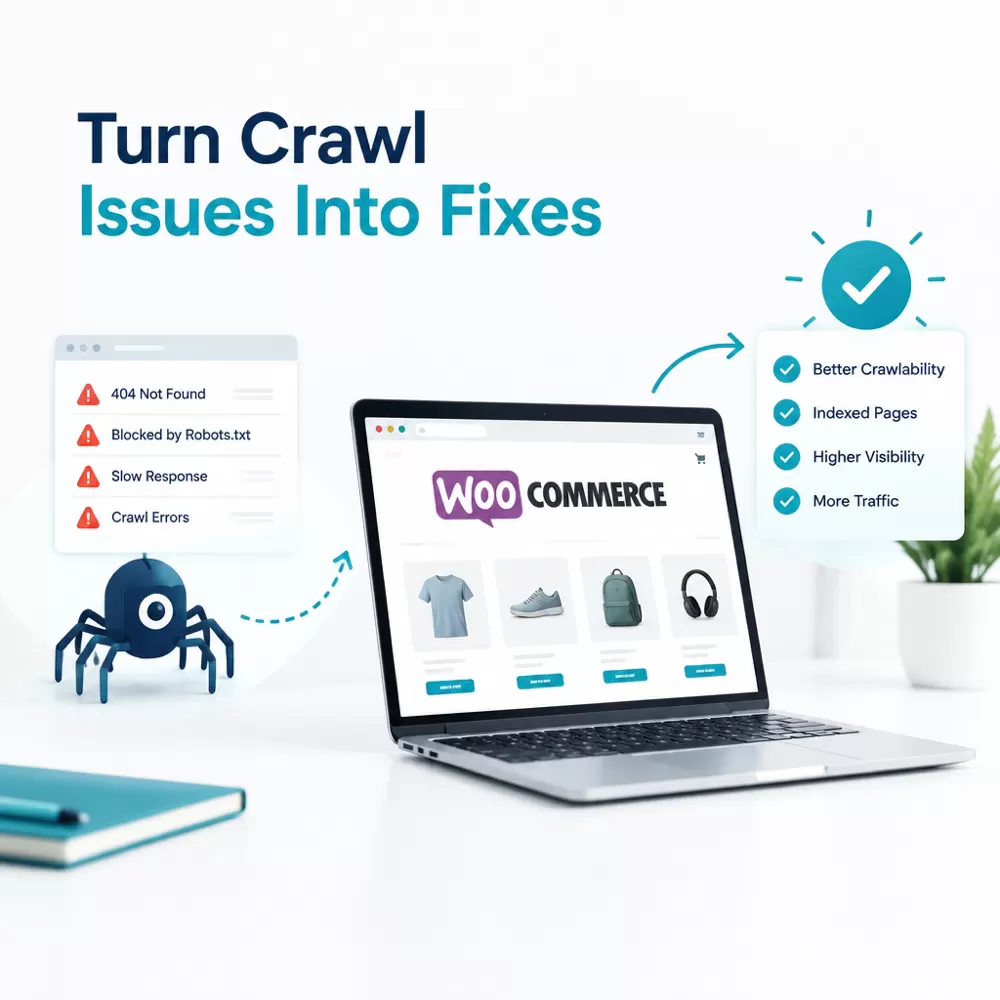
Start by translating the crawler’s label into a page-level problem. “Duplicate page” is not enough to guide a developer. Identify the affected URL pattern, how the URLs are generated, which pages matter to shoppers, and what a search engine currently sees. For example, a crawl may find many URLs for one product because a filter or variation adds parameters to the address. That does not automatically mean every URL needs to be removed.
Next, group related findings and assess their likely impact. A problem affecting the main product template deserves more attention than an isolated warning on an old, low-value page. A simple issue record can keep decisions clear:
- Finding: What did the crawler detect, and which URL pattern is involved?
- Evidence: Can the issue be reproduced in a browser, page source, or rendered page?
- Impact: Does it affect an important product, category, or customer journey?
- Action and owner: What should change, and who can safely make that change?
- Verification: Which URLs and signals will confirm the result?
This triage step prevents a common mistake: treating every crawl alert as an urgent technical defect. Some findings are expected behavior, and others need a business decision before implementation. A filter URL, for instance, may be useful to shoppers but not worth indexing as a separate landing page. The right handling depends on whether it serves a distinct search need, whether it has useful inventory, and how the store creates and links to it.
Choose the right fix for variations, filters, and schema
Product variation URLs need to be reviewed in the context of the store’s setup. A variable product may use one parent product page, while a theme, extension, or custom configuration can expose selected options through URL parameters. First check whether these addresses show substantially different content, whether they are internally linked, and whether search engines have indexed them. If the options are simply selections on one product page, the implementation may need to consolidate signals around the parent URL. If a variation has distinct inventory, content, or search demand, a separate indexable page might deserve consideration instead. Avoid changing URL behavior before checking how shoppers use it and how the catalog is maintained.
Filter-generated URLs require similar care. Faceted navigation lets shoppers narrow products by size, color, price, or other attributes, but combinations can create a large number of crawlable addresses. Decide which combinations offer useful, stable landing pages and which are just navigation states. Then choose controls that match the decision, such as limiting internal links to low-value combinations or setting appropriate canonical and indexing directives. A canonical tag suggests a preferred version, while a noindex directive asks search engines not to index a page. Neither should be applied sitewide without checking the pages it affects. Blocking URLs in robots.txt can also prevent crawlers from seeing page-level directives, so it is not a substitute for a considered indexing plan.
Conflicting schema output often comes from multiple sources, such as a theme and one or more extensions adding structured data to the same page. Inspect both the source and rendered product page to identify which component emits each markup block. Check that product details such as price, availability, and product identity match what shoppers can see. Then coordinate with the developer or extension owner to remove or adjust the duplicate output. Do not strip all schema just because a testing tool reports a conflict. After the change, test representative product and category templates, and recheck the rendered markup. Structured data can help search engines interpret page information, but it does not guarantee enhanced search displays.
For each fix, record the affected templates and sample URLs before work begins. Make the change in a staging environment when possible, especially if it affects permalinks, indexation, or shared product templates. Confirm that filters still work for shoppers, product options remain usable, and important pages still return the expected status code. A technically clean crawl is useful only if the store continues to function.
How to choose a WooCommerce SEO agency and verify the work
Store owners should look for a partner that explains findings in terms of pages, risk, implementation, and measurement. Ask how the team distinguishes a crawler warning from a problem that affects search access or customer experience. Ask who will coordinate changes in the WooCommerce setup, how staging and approvals work, and what evidence will appear in the closeout report. If an agency recommends changing canonicals, indexing directives, or URL rules, it should be able to explain which templates and URL groups are included.
SEO Deep Insights describes its WooCommerce service as covering SEO, Answer Engine Optimization (AEO), and Generative Engine Optimization (GEO), alongside technical fixes, local visibility, content, ethical link building, and reporting tied to leads and revenue. For a store that needs help moving from audit to implementation, its woocommerce seo agency service page is a useful place to review that scope. During a conversation, confirm which parts apply to your store and what access or developer support the work requires. Service descriptions are a starting point, not a substitute for a specific plan.
After implementation, verify the outcome with a repeatable check. Crawl a sample of affected URLs and compare status codes, canonical tags, index directives, internal links, and schema against the intended behavior. Use Google Search Console to review indexing and enhancement reports where relevant, but allow for reporting delays and remember that a crawl tool and Google may see pages differently. Track whether the targeted URL patterns change over time, then monitor important product and category pages for unintended effects.
A practical next step is to select the three findings with the clearest impact on valuable pages. For each, document the affected URL pattern, the desired behavior, the person responsible, and the test that will confirm the change. If the issue crosses theme, extension, and SEO settings, involve a specialist before editing production templates. That gives the store team a controlled path from crawl evidence to a verified fix, while keeping the focus on shoppers and useful organic visibility.