

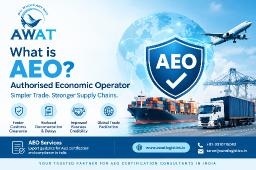
International trade involves several procedures, including customs clearance, documentation, cargo movement, and supply chain compliance. For businesses looking to simplify these processes and improve their international trade operations, the Authorised Economic Operator (AEO) programme can be an important advantage.
In India, the AEO programme is administered by the Central Board of Indirect Taxes and Customs (CBIC). It recognises eligible businesses that demonstrate a strong compliance record and meet the prescribed requirements for secure and efficient international supply chains.
If you are an importer, exporter, manufacturer, freight forwarder, customs broker, or warehouse operator, understanding AEO certification can help you identify opportunities to improve operational efficiency and strengthen your credibility in global trade.
AWAT Logistics provides guidance and assistance for businesses seeking AEO-related certification and compliance support.
The AEO full form is Authorised Economic Operator.
An AEO is a business or organisation involved in the international movement of goods that has been recognised by Customs authorities for meeting specified compliance and, where applicable, supply chain security requirements.
The AEO programme aims to facilitate legitimate international trade while strengthening the security of the global supply chain. Eligible certified entities may receive benefits such as faster customs processing, reduced examinations, and other facilitation measures, subject to the applicable rules and certification tier.
In India, the AEO programme is managed by CBIC and supports the government's efforts to promote trade facilitation and ease of doing business.
AEO certification in India is a recognition granted to eligible businesses that meet the requirements of the Indian Customs AEO programme.
The certification indicates that a business has established appropriate compliance practices and can demonstrate its ability to maintain relevant records and follow applicable Customs requirements.
Depending on the applicant's business activity and the tier granted, AEO status may provide operational and financial advantages.
Businesses commonly explore AEO certification to:
AEO certification is not mandatory for every importer or exporter. It is an optional programme for eligible businesses that wish to benefit from the applicable trade facilitation measures.
The Indian AEO programme has different categories based on the applicant's role and compliance readiness.
AEO-T1 is an entry-level category for eligible importers and exporters. It offers Customs facilitation and other benefits to businesses that meet the prescribed eligibility requirements.
AEO-T2 is designed for eligible importers and exporters that meet enhanced programme requirements. It provides additional facilitation benefits compared with T1, subject to the applicable conditions.
AEO-T3 is an advanced category for eligible businesses that already hold AEO-T2 status and satisfy the prescribed conditions for progression to T3.
AEO-LO is intended for eligible logistics operators, including specified logistics service providers, custodians, terminal operators, customs brokers, and warehouse operators.
This category is particularly relevant to businesses involved in cargo handling, storage, transportation, and other international supply chain activities.
The appropriate category depends on the nature of your business, your existing certification status, and the current eligibility requirements. Applicants should consult the official AEO India portal for the latest criteria.
Obtaining AEO certification can help eligible businesses improve their international trade operations.
AEO-certified businesses may receive priority facilitation and reduced routine examinations, where applicable. This can help improve cargo movement and reduce unnecessary operational delays.
Well-maintained records and documented procedures can support smoother interactions with Customs authorities. Certification does not eliminate documentation requirements, but it can make compliant operations more predictable.
Depending on the category and applicable rules, eligible entities may receive benefits related to bank guarantees, deferred duty payments, refunds, or other financial procedures.
These benefits are subject to specific conditions and should not be assumed to apply to every AEO-certified business.
AEO status demonstrates a recognised commitment to Customs compliance and supply chain security. This may strengthen confidence among customers, suppliers, and international trading partners.
More predictable Customs procedures can help businesses coordinate transportation, warehousing, inventory, and delivery schedules more effectively.
India's mutual recognition arrangements with certain partner economies may offer additional facilitation to eligible AEO entities. The actual benefits depend on the applicable arrangement and the participating Customs administrations.
The AEO programme is relevant to eligible businesses that participate in international trade or the international supply chain.
Potential applicants include:
Applicants must satisfy the requirements applicable to their category. These can include a suitable compliance history, accurate and auditable records, documented procedures, financial solvency requirements, and security controls where prescribed.
Businesses should assess their eligibility before submitting an application.
The process generally involves preparation, online application, document review, verification where required, and a certification decision.
Identify the correct AEO category according to your business activities. Review the current CBIC requirements to determine whether your organisation meets the eligibility conditions.
Organise your business, registration, compliance, accounting, and operational records as required for the selected category.
Depending on the applicant type, relevant records may include:
The exact document checklist varies by category and the current application requirements.
Visit the official Indian AEO portal to create an applicant account or access your existing account.
Ensure that the information entered matches your official business records and that your registered contact details are accurate.
Select the appropriate category, complete the application, and upload the required supporting documents. Review the information carefully before submission to reduce the likelihood of avoidable queries.
The relevant authorities may examine your application and request clarifications or additional evidence. Verification of business processes, records, controls, or premises may be required, depending on the application category.
After the required review and verification, the authorities communicate their decision. If approved, the business receives the applicable AEO status and must comply with ongoing programme requirements.
Important: Processing time depends on the category, completeness of the application, verification requirements, and any clarifications requested by the authorities.
The keyword AEO login generally refers to accessing the official AEO portal to manage an application or an existing certified entity's account.
Applicants may use the portal to perform relevant activities such as:
Use your registered credentials and follow the portal's instructions. If you are a new applicant, complete the registration process first. Never share your password or one-time password (OTP) with unauthorised persons.
Although the application process is structured, businesses may encounter difficulties during preparation and submission.
Common challenges include:
Preparing documents in advance and reviewing the applicable requirements can help businesses avoid preventable errors.
Businesses seeking AEO services may benefit from professional guidance when assessing eligibility, organising documentation, and preparing for the application process.
AWAT Logistics supports businesses seeking assistance with AEO-related certification requirements and international trade compliance.
Depending on your business needs, AEO support may include:
The scope of support depends on the client's business activity and requirements. Certification decisions are made by the relevant Customs authorities, and professional assistance does not guarantee approval.
Businesses often ask how AEO certification differs from standard Customs procedures.
Regular Customs procedures apply according to the relevant laws, regulations, and risk assessment systems. AEO certification provides eligible businesses with additional facilitation measures under the programme, depending on their approved category.
AEO status does not exempt a business from all Customs regulations, duties, documentation, or inspections. Instead, it recognises qualifying businesses and may provide specific operational advantages under the applicable rules.
For businesses with regular import-export activity, assessing the potential benefits against the requirements of maintaining AEO status can help determine whether applying is worthwhile.
AEO stands for Authorised Economic Operator. It is a Customs recognition programme for eligible businesses involved in international trade and supply chain activities.
AEO certification is recognition under India's Customs programme for businesses that meet the prescribed eligibility, compliance, and other applicable requirements.
No. AEO certification is generally optional. Eligible businesses can decide whether to apply based on their activities and the potential benefits.
Potential benefits include faster Customs processing, reduced routine examinations, certain financial or procedural facilitation measures, and stronger recognition as a compliant supply chain partner. Benefits vary by category and applicable conditions.
AEO login allows registered users to access the official portal to manage applications, track progress, upload documents, and perform other permitted account activities.
Review your eligibility, prepare the required records, register or log in to the official AEO portal, submit the application, and respond to any review or verification requirements.
Eligible logistics service providers and other qualifying supply chain participants may apply under the appropriate category, including AEO-LO where applicable.
AWAT Logistics can provide guidance on eligibility, document preparation, application readiness, and related compliance requirements. Final certification is subject to approval by the competent Customs authorities.
The Authorised Economic Operator programme is an important initiative for improving trust, compliance, and efficiency in international trade. For eligible importers, exporters, freight forwarders, and warehouse operators, AEO certification in India may help streamline applicable Customs procedures and improve supply chain predictability.
Understanding the AEO full form, the available certification categories, the potential benefits, and the official application process is the first step towards making an informed decision.
If your business is considering AEO certification, AWAT Logistics can help you understand the process and prepare for the applicable requirements.
Make your international trade operations more organised, compliant, and efficient with the right AEO preparation strategy.
| No comments yet. Be the first. |

