


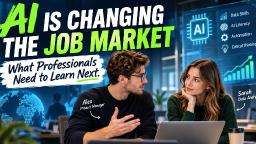
Two colleagues. Two different careers. One changing job market. And a question neither can ignore: Are we keeping up with AI?
It's Monday morning at a tech company in Seattle. Alex, a Product Manager, is reviewing his team's product roadmap when Sarah, a Data Analyst, walks over with her coffee.
Their conversation starts with an upcoming project but quickly shifts to something they've both been thinking about lately: AI and the future of their careers.
Sarah has noticed that companies are looking for analysts who can do more than build dashboards. Alex is seeing similar changes in product management. Employers increasingly expect professionals to understand AI, work with new tools, and make faster, data-backed decisions.
Neither is worried about technology itself. What concerns them is whether their current skill sets will be enough for the next stage of their careers.
Sarah (Data Analyst): Have you noticed how different job descriptions look now? A few years ago, most data analyst positions focused on SQL, Excel, and visualization tools. Now, I'm seeing AI, automation, and machine learning mentioned everywhere.
Alex (Product Manager): I've noticed the same thing. Product management roles are changing too. Companies want PMs who can understand AI-powered products, analyze customer behavior, and use AI tools to make better product decisions.
Sarah: That's what got me thinking. If AI can clean datasets, generate reports, and identify patterns in minutes, what happens to the traditional data analyst role?
Alex: I don't think the role disappears. But the expectations are changing. AI can identify a trend, but someone still needs to understand why it matters, whether the data is reliable, and what the business should do about it.
Sarah: So knowing how to work with data isn't enough anymore. We need to know how to turn it into decisions.
Alex: Exactly. And that's happening across the job market, not just in analytics.
Sarah: I recently used ChatGPT to analyze a sales dataset. It helped me write Python code, identify unusual patterns, and summarize the results. A task that would normally take hours took much less time.
Alex: That's similar to how I'm using AI. I rely on it to summarize customer feedback, research competitors, draft product requirements, and organize feature ideas.
Sarah: It sounds like we're both getting more work done with fewer manual steps.
Alex: We are. But companies aren't simply looking for people who know how to use ChatGPT. They want employees who can apply AI to real business problems.
That's an important distinction. Being able to generate a report is useful. Knowing which business decision that report should influence is much more valuable.
For professionals in the US, this means AI literacy is becoming an important addition to existing technical and business skills. The ability to combine industry knowledge, critical thinking, and AI tools can make employees more competitive.
Sarah: If I want to grow in data analytics, what should I focus on next? I already know SQL, Excel, and Power BI.
Alex: I'd build on those skills rather than start from scratch. AI-powered analytics is a good next step.
Sarah: What would that actually look like?
Alex: For starters, learn how to use AI tools to explore datasets, generate Python scripts, automate reports, and identify patterns. Then work on predictive analytics and understand the basics of machine learning.
Sarah: So I don't necessarily need to become a machine learning engineer?
Alex: Not unless that's the career direction you want. A strong data analyst should understand how AI works, where it can help, and where its predictions can go wrong.
Sarah makes a note of the skills she wants to develop:
Advanced SQL and Python for data analysis.
Power BI and Tableau for data visualization.
AI-assisted analytics and reporting.
Predictive analytics and machine learning fundamentals.
Business intelligence and data storytelling.
She realizes that her next career move doesn't necessarily require changing professions. It requires expanding what she can do within her existing role.
Sarah: You're talking about analytics, but how much has AI actually changed your day-to-day work?
Alex: Quite a bit. Earlier, I spent a lot of time researching competitors, reviewing customer feedback, writing PRDs, and organizing feature backlogs. Now, AI helps me move through those tasks much faster.
For example, I can use tools like ChatGPT and Claude to summarize customer reviews, identify recurring product issues, draft user stories, and explore potential product features.
Sarah: So does that mean product managers have more time for strategy?
Alex: That's the goal. But using AI doesn't automatically make someone a better product manager.
You still need to understand customer needs, prioritize features, work with engineering teams, define product strategy, and measure business outcomes.
AI might suggest ten new features. A product manager needs to figure out which one is worth building and why.
Sarah: That sounds like the real advantage: combining AI capabilities with product judgment.
Alex: Exactly. Companies need PMs who can understand both the technology and the business behind it.
Sarah: It seems like both our careers are moving in the same direction, even though our jobs are different.
Alex: That's because AI skills are becoming relevant across industries. You don't have to become a developer to benefit from AI.
Sarah: Then what should professionals actually focus on?
Alex: I'd start with six areas:
AI Literacy: Understand generative AI, large language models, and how AI-powered applications work.
Prompt Engineering: Learn to communicate clearly with AI tools and get useful, reliable results.
Data Analysis: Develop the ability to interpret information and make evidence-based decisions.
Workflow Automation: Explore tools like Zapier and Make to reduce repetitive work.
Critical Thinking: Learn to question AI-generated answers, identify inaccuracies, and evaluate recommendations.
Business Understanding: Connect your skills to customer needs, revenue, productivity, and business growth.
These skills can support career growth in product management, data analytics, marketing, finance, operations, and many other fields.
Sarah: I think I've been looking at AI as something that could take over parts of my job. Maybe I should start looking at it as a way to become a better analyst.
Alex: That's a much better starting point. But learning new tools is only half the work. You need to demonstrate that you can use them.
Sarah: You mean building projects?
Alex: Exactly. If you're a data analyst, build a project that uses AI to analyze business data, identify trends, or automate reporting. If you're a product manager, develop an AI-powered product concept. Define the target audience, identify a real problem, create a product roadmap, and decide how you'll measure success.
Sarah: That would give us something concrete to show employers instead of just listing AI tools on our resumes.
Alex: Right. Practical experience makes your skills easier to demonstrate during interviews and gives you something meaningful to discuss.
By the time their coffee is finished, Sarah has a new learning plan, and Alex has a few AI-powered product ideas to explore.
Neither believes they need to abandon their careers to keep up with technology. But both understand that the skills that got them their current jobs may not be enough to take them to the next level.
The US job market is evolving, and AI is becoming part of how businesses build products, analyze information, serve customers, and make decisions.
Whether you're a Product Manager, Data Analyst, Software Developer, Marketer, or working in another field, the opportunity is to combine your existing expertise with new AI capabilities.
Because the real career advantage isn't simply knowing how to use AI. It's knowing how to do your job better with it.
| No comments yet. Be the first. |
