


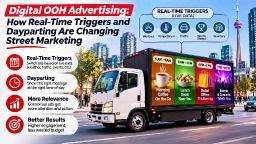
Digital OOH advertising changes street marketing by letting brands switch messages based on time, weather, and live data. Real-time triggers respond to events as they happen. Dayparting schedules different ads for different parts of the day. Together, both methods make outdoor ads more relevant than static billboards.
Digital out-of-home (DOOH) advertising is the use of digital screens to display ads in public spaces. Examples include LED billboards, transit screens, and digital OOH advertising on mobile LED trucks. Static billboards show one printed message for weeks. Digital screens change creatives within seconds.
Real-time triggers are data signals that automatically change which ad a digital screen displays. A trigger connects an external data source to a creative rule. When the data meets the rule, the screen switches the ad.
Common trigger types:
|
Trigger |
Data Source |
Example Ad Response |
|
Weather |
Weather API |
Rain triggers a rideshare or umbrella ad |
|
Temperature |
Weather API |
Heat above 30°C triggers an iced drink promotion |
|
Time |
Screen clock |
Evening triggers a restaurant dinner offer |
|
Traffic |
Traffic data feed |
Congestion triggers a podcast or radio ad |
|
Sports scores |
Live score feed |
A home-team win triggers a celebration offer |
|
Inventory |
Retail stock system |
Low stock triggers a "last chance" message |
Dayparting splits the day into time blocks and assigns a different ad to each block. The method matches the message to the audience present at that hour. Commuters, lunch crowds, and evening shoppers want different things.
A typical Toronto dayparting schedule looks like this:
|
Daypart |
Audience |
Best Ad Type |
|
6 AM to 9 AM |
Commuters on the 401, DVP, and Gardiner |
Coffee, news, transit, breakfast |
|
11 AM to 2 PM |
Office workers and lunch crowds |
Restaurants, food delivery, lunch deals |
|
4 PM to 7 PM |
Evening commuters |
Retail sales, fitness, dinner offers |
|
7 PM to 11 PM |
Nightlife and event crowds |
Entertainment, concerts, bars, ride services |
Both methods improve results because they raise relevance. A relevant ad earns more attention than a generic one. Advertisers also waste less budget on mismatched messages.
Key benefits include:
Brands use real-time triggers to link advertising to the viewer's immediate situation. Three examples show the pattern:
Digital OOH platforms connect data feeds to screens and schedule creatives automatically. Broadsign, Hivestack, and Vistar Media are programmatic and content management platforms used across the DOOH industry. Smaller advertisers usually work through an outdoor advertising company that manages the platform and creative scheduling.
Yes, mobile LED trucks use dayparting well because drivers can change both route and message by time block. A mobile digital billboard truck can cover downtown offices at lunch and entertainment districts at night. Each stop gets its own creative.
A Mobile Billboard Advertising Truck from Media Trucks in Toronto adds route flexibility that fixed screens cannot match. Advertisers pick the neighbourhood, the hour, and the message.
Set up a dayparting campaign by matching audience patterns to time blocks. Follow these steps:
Measure digital OOH with trackable actions tied to each creative. Without tracking, advertisers cannot compare dayparts or triggers.
Reliable methods include:
Avoid overcomplicated creatives, unreliable data feeds, and untested rules. Viewers read outdoor ads in a few seconds.
Real-time triggers and dayparting make digital OOH advertising more relevant and more measurable. Start with a simple daypart schedule, add a trackable call to action, and expand into data triggers once the basics perform.
What is dayparting in digital OOH?Dayparting is scheduling different ads for different times of day.
Do real-time triggers require special technology?Yes. A DOOH platform must connect a data feed, such as weather, to the screen.
Are digital OOH ads better than static billboards?Digital OOH ads suit campaigns that need timing, variety, and fast changes. Static billboards suit long-term brand presence in one place.
Can small businesses use digital OOH?Yes. Mobile LED trucks and short-term screen buys fit smaller budgets.
| No comments yet. Be the first. |
