


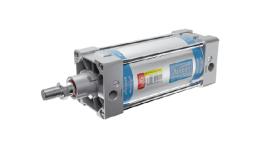
Industrial machines often require controlled linear movement over longer distances. In such applications, selecting the correct long stroke pneumatic cylinder is important for achieving the required movement, maintaining operational efficiency, and supporting reliable machine performance.
Long stroke pneumatic cylinders use compressed air to generate linear motion over an extended distance. They are commonly used in material handling, packaging machinery, automation systems, manufacturing equipment, and other industrial applications. However, choosing the right cylinder requires careful consideration of stroke length, operating pressure, load capacity, mounting arrangement, and available installation space.
Stroke length refers to the distance the cylinder piston travels between its fully retracted and extended positions. Before selecting a cylinder, determine the exact movement required by your machine.
A cylinder with insufficient stroke length may not complete the required operation, while an unnecessarily long stroke can increase installation space and overall equipment dimensions.
Measure the required travel distance and consider the machine's operating cycle before finalising the cylinder specification.
The force generated by a pneumatic cylinder depends mainly on its bore diameter and operating air pressure.
A larger bore generally produces greater force at the same pressure. However, the actual available force is affected by friction, pressure losses, and mechanical efficiency.
When selecting a cylinder, consider the weight of the moving load, resistance during movement, and any additional forces created by the machine mechanism.
For reliable operation, engineers should calculate the required force for both extension and retraction rather than selecting a cylinder based only on its physical size.
Compressed air pressure directly influences cylinder performance. Different pneumatic systems operate at different pressure levels, so the selected cylinder must be compatible with the available air supply.
Check the manufacturer's rated operating pressure and ensure that the cylinder is suitable for the pressure conditions in your machine.
Stable air pressure is also important for achieving predictable movement. Proper filtration and pressure regulation can help protect pneumatic components and support consistent operation.
The bore diameter determines the piston area and significantly influences the force generated by the cylinder.
A cylinder with a smaller bore may be sufficient for lightweight applications, while heavier loads may require a larger bore.
However, selecting an unnecessarily large bore can increase compressed air consumption. The ideal size should provide sufficient force without creating unnecessary energy consumption or installation costs.
Long stroke cylinders require adequate space for their extended and retracted positions. Buyers should check the available installation length, mounting position, connecting arrangements, and surrounding machine components.
Common mounting options include foot mounting, flange mounting, and clevis mounting, depending on the cylinder design.
Correct alignment is equally important. Misalignment can introduce side loads on the piston rod, increasing wear and potentially reducing cylinder service life.
Piston rod strength becomes particularly important in long stroke applications. Longer rods may be more vulnerable to buckling or bending when subjected to compressive loads.
The cylinder should therefore be selected according to load direction, unsupported rod length, mounting arrangement, and operating conditions.
Cushioning is another important feature. Adjustable end cushioning helps reduce piston impact near the end of its stroke, which can minimise noise and mechanical stress when correctly configured.
Cylinder construction materials influence durability and suitability for different industrial environments. Buyers should evaluate barrel materials, piston rod finish, seals, and corrosion resistance according to the application.
Regular inspection of seals, air connections, piston rods, and mounting components helps identify wear or leakage before they affect machine operation.
Airmax Pneumatics Ltd operates in the pneumatic equipment sector, where selecting suitable cylinders and understanding application requirements are important for industrial automation.
Conclusion
Choosing the right long stroke pneumatic cylinder requires more than selecting a suitable stroke length. Bore diameter, operating pressure, load capacity, piston rod strength, cushioning, mounting arrangements, and maintenance requirements all influence performance.
By evaluating these factors before purchasing, manufacturers can select cylinders that match their machine specifications, support reliable linear movement, and improve the efficiency of industrial automation systems.
| No comments yet. Be the first. |
